
I was young. A boy. Maybe eight. My older brothers and I had gone with our father to a gravel and asphalt lot. Seems like it was a truck stop. You never forget your first sight of death, or the knowledge that someone has died, and you didn’t see it, but you’re staring at the evidence of it. My oldest brother was always impatient. I think he nudged some gravel sideways with a foot. A diesel whine, low and working hard as it pulled weight uphill came to the ears, then my brother with his foot in the gravel said, “This must be it.”
Then it came into view, a huge towing rig, one not meant for a car. Trucks have changed so much since the 1960s that I can’t really see the make. Couldn’t tell you if it was a Mack, International or Brockway. But I clearly remember what it was towing. You never forget that first time you look at something and realize it killed someone.
***
It was terrible, because I’d had toy trucks. One was a wired remote control semi with a flatbed. Topper Toys’ Johnny Express. Funny enough, I found it frustrating. Of course my father had to show me how to back it up, like to a dock. Even with toys, he was a bastard. He’d yell at me for not catching on fast enough to suit him. I never liked it, though. At night, it looked like the driver moved. And that thing in my room probably enjoyed that.
The toy broke. It was so cheap that its front spindles broke. There was no way to fix them so it got trashed. I just didn’t think much of trucks after that, but my young brain couldn’t comprehend the idea that they were lethal. Until, that is, two years after Johnny Express crapped out on me.
***
The tow truck was pulling a whole rig, an eighteen wheeler. And it was so mangled that I knew the tractor was there, but it didn’t look like one. I’ve seen a shitload of wrecked eighteen wheelers in my time, some of which were serious, and some that didn’t look that bad but someone, usually the driver or a car driver, was killed. I’ve never seen anything as bad as what I saw that day.
I don’t remember what the weather was like. I don’t know exactly where we were, but it wasn’t dad’s terminal in Frederick. I believe it was some kind of repair and storage facility for trucks. It was probably the closest place to the accident scene to tow the mangled lumps of steel to.
The story was horrible and unforgettable; the driver had been going down a mountain, a somewhat steep grade, not the worst, say nine percent. But the trip down lasted for five miles. That is a long time to hold back a trailer loaded with freight. And in the mid-60s, that was a serious issue.
Back then, the super rigs of today weren’t even dreams yet. If you were around back then and traveled the highways between states, you’ll remember the strong smell of diesel fumes belched from stacks with telltale black smoke trailing the rig. There were no emissions regulations. And it was rare to see a van (box) trailer or any other with a length in excess of 35-40 feet. That was a restriction; strict total rig weight and length guidelines were enforced by the Department of Transportation (DOT) at roadside weigh stations.
The problem with steep grades wasn’t so much the ascent, unless a driver missed a gear and couldn’t find another to match his speed and RPMs fast enough, and I’ve seen the end result of that situation myself. Coming down a mountain backwards has always had a bad ending.
The descent from a mountain or “hill” was a bitch. There were limitations to the equipment of the day. Mainly, there’s what we call “pancake brakes”. There was nothing else. It was a small brake chamber, one for each side of each axle, both tractor and trailer. The problem was, they were operated by compressed air, as are all truck and trailer brakes, to this day. Every truck had an air compressor, and heavy duty hoses between the tractor and the trailer would send that air to the chambers. If anything went wrong, it meant no brakes. There was a rubber diaphragm in the brake chambers that could easily be blown out. Loss of air pressure then affected the entire braking system and going downhill meant a rig became a runaway. There was nothing to stop it.
Here is a link to Michigan Truck Spring Company with an excellent 5 minute video explaining and demonstrating the differences between air brake types. The larger chambers are typically referred to as “maxi brakes” or chambers. They last longer, and if air pressure drops, it engages. All brakes engage, or lock up, which can stop the truck. Usually.
BACKBONE
It sits in two states, West Virginia and Maryland. In Maryland it holds the highest peak in the state, over 3,000 feet. Not huge, but a problem for truckers. Although the mountain might be high on the other side of the state line, it makes little difference.
Backbone is said to be haunted by ghosts of people who died suddenly there, but I’ve found no specific anecdotal information of such. Yet I find no reason not to believe they’re out there.
Because people do die there. At the peak on the Maryland side, one can see the North Branch Potomac River, “Potowmack” to settlers, and its history goes much further back than those.
While some deaths were caused by violence, some more recent ones were accidents. Maryland state route 135 is a long, usually two-lane, two-way-traffic rural route that kills people.
I’ve never known why a trucker would choose this route to come out of West Virginia into Maryland. In the 1960s, there may have been no choice, or little in the way of options; however, my father forbade his drivers from using that route. He expected them to properly distribute net weight by moving or adjusting the bogie, the name for the suspension and dual wheels on a trailer. It’s guesswork, but a seasoned trucker can put it right where he or she needs it to be to weigh legal at a weigh station. So long as the rest of the rig is in order, no air leaks, no safety problems, the scales on main routes let you go on your way.
You see, one reason for traveling north and east on 135 is to avoid the scales. They used to be along US routes 40 and 48, which is now Interstate 68, even though the old routes still have parts in use beside it. For the former Luke Paper Mill, which shipped huge rolls of paper and required a rig to haul them, there was no alternative. Otherwise it was prudent to avoid that section of the road.
As a northeastern route, just past the Bloomington Cemetery, it had the 9 percent grade turn sharply to the right at the bottom of the descent. At speed, this was impossible for a rig, and even some cars. Back then a trucker had only a sheet map to guide him, and those gave no topographic information nor warning of any feature that posed a danger. At the top of the steep descent, they were ignorant of what they were about to go through, and I’m sure they geared down, but it wasn’t enough for five miles of 9 percent. They would realize halfway down, but by then it was too late. They’d fan the brakes, engaging the brake pedal and releasing it to prevent the brake shoes from catching fire, which they often did anyway despite containing asbestos.
What they found out was that at the bottom of the grade, where 135 made an impossible right turn, there was an old retaining wall. It was built to hold back erosion from the land beyond it, but the truckers often hit it. Usually they were killed. One truck struck the wall at 75 miles per hour, and the responders knew this because that’s where the speedometer was stuck. That guy was killed on impact.
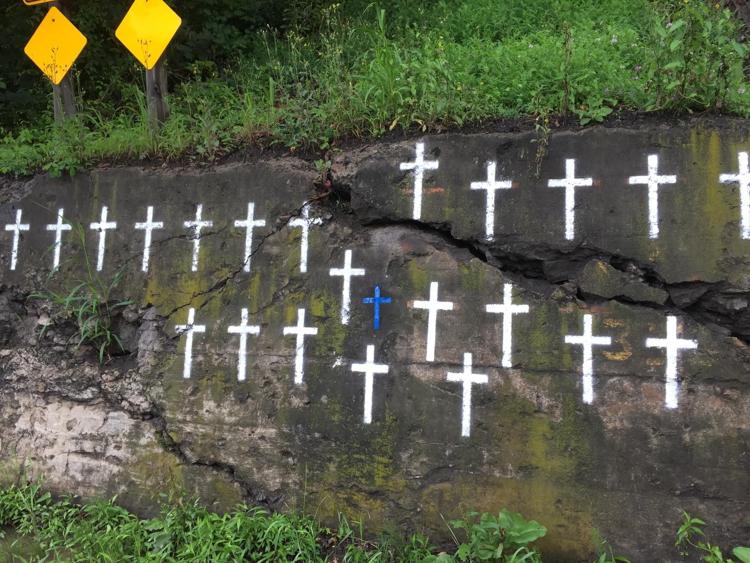
Over the years, someone, no one knows who, started painting white crosses on the wall for each dead trucker. There were fewer the day I saw the tow truck pull in with a mangled chunk of steel and a twisted flatbed trailer behind it. There are more now, but inadequate for the real number of men who met their end there.
***
It was raining on 135 the day it happened, and descending, the driver was unfortunate enough to lose traction on his trailer tires by means of using the trailer’s brakes, excessive speed and, of course, the wet road. Trailers that lose traction slide, picking up speed, which sends the trailer sideways in a deadly dance called a jackknife. Once, decades later, I had a rig do this to me in the snow, but I recovered, straightened out, but still shook for a week. It’s a damned scary thing.
My father’s driver could not recover and the flatbed slid into a full sideways jackknife and a woman driving a car in the oncoming lane was decapitated. Her son, in the passenger seat, suffered a broken arm. But it wasn’t over yet. Now in runaway mode, the rig struck the wall cab-first and turned everything into scrap metal. It’s odd that I can’t remember if he died, but I want to say he survived. Because I’m thinking he was in a hospital for a while, and was never the same again. Damn, his name is on the tip of my tongue and yet evades me. Not that I would use it anyway.
Since then the Maryland highway administration put up warning signs. They made brake-check stops along the side of the road and later, an escape ramp filled with pea gravel to slow a runaway rig down and stop it. Over 20 white crosses were on the wall, decades on, when the state installed flashing lights, warning signs and a computerized speed sensor that will warn a trucker a mile ahead of time that the escape ramp is a mile ahead and his or her speed requires its use.
All good things, to be sure, but the lives already lost combine to put the wall into American legend. One time, a tanker filled with hydrochloric acid came down too fast. Another trucker had pulled over beside the wall to sleep. Neither survived.
In 1986, I dispatched a driver from Glen Burnie, Maryland to Parsons, West Virginia for a load of charcoal on an overseas container destined for the Dundalk Marine Terminal and some European port. The guy was green, and he used this route, and my father tore his ass for it. But the greenhorn made it back in one piece. From that day on, another driver named Buck refused to use his name, calling him “Ol’ 135”.
Every year the crosses on the wall are painted afresh on Memorial Day. In the center is a blue cross which bears the saying, “Jesus Saves.”



 Memoirs of an American Asshole
Jeez Mike. I love your writing. I know it’s good because even now I can see the scenes from the first half of the AMAZING book you wrote. And I can see those trucks now too. You need to be published already. There are quite a few sites that will pay you for writing reviews $100 for a 300 synopsis or review. Google it. You can make some great pocket money and I’m sure once you become known you’ll be able to make some real money. I love you. Xoxo.
LikeLiked by 1 person
Writing reviews doesn’t appeal to me, but thanks for the advice. Thank you as always for reading and being enthusiastic. I couldn’t be more grateful.❤
LikeLike