She said a lot there, but everyone is asking the same things here in the United States.
What I’m getting from this is disturbing because it seems that nobody knows what the U.S. is allowed to do, what our constitution provides for or forbids, what the UCMJ allows or what constitutes criminal actions, and equally important, what international law says about combat actions in international water during peacetime. Especially against civilians.
I’ll let you in on something really messed up: there are no countries that are allowed to do this. It could constitute a war crime, but there is no war, so these horrors are crimes against humanity, and terrorism; Murder and the threat of more. Except, I don’t understand why it’s happening if Trump just pardoned Juan Hernandez, former president of Honduras, who was convicted of trafficking cocaine into the United States by the ton.
How in perdition does that make any sense?
Answer: it doesn’t.
I honestly knew nothing about the 2 September incident in which the so-called “double tap” strike took place until mere days ago.
I’ll tell you my take as a Christian first: I believe the “first strike” to be immoral. Killing is immoral. My renewed faith has no room for arguing this point. Defense against an aggressor in a declared war is one thing; this is nothing similar at all. Jesus never said to go forth and kill and then pretend it never happened. Killing and lying are not just sins, but they go against the conscience most people are inherently equipped with.
So too, Pete Hegseth proved to be a coward, speaking boldly, indeed arrogantly, and then lying to cover himself from any fallout. Which he’s finally getting anyway.
FAKE NEWS
This is something we all have to contend with. It’s a problem because, first of all, some people like to disseminate lies. Secondly, propaganda is effective. Hitler had a dedicated propaganda minister, and the Allied resistance countered Nazi propaganda with outrageously funny and equally effective stunts through the use of radio and printed material. The underground was often connected between occupied countries and those involved risked their lives in their own fight against Nazis.
The Resistance against Nazi Germany was often funny, and one case in particular taught the Kriegsmarine in Norway an unforgettable lesson. Germany had confiscated the entire country’s catch of sardines because canned food lasted longer on U-boat sorties. U-boats were hot, cramped, and they went on long “Wolpack” patrols across the Atlantic to sink Allied escorts and troop ships, but also to stem the unbelievable flow of planes, tanks and a staggering amount of food, medical supplies, uniforms and blankets, a never-ending amount of ships, and while the Germans, including armored cavalry, pilots, and infantry, had been told that the U.S. military was weak and could never outfight Aryans, the Kriegsmarine knew better. Not only could they not stop the shipping, but the Americans became much more efficient at detecting and damaging or sinking their subs. It became necessary for the Nazi armed forces to take drastic measures. Occupied countries had crops and meat confiscated. Troops were resorting to horses and carts for transportation of troops and supplies, and horses were used to pull artillery, some of which were very antiquated pieces from World War One. Combat photography and film footage proves all of this, and perhaps there was a time when they may have prevailed except that Operation Barbarossa had already beaten them. It is the judgement of many scholars that it was inevitable; invading the Soviet Union was a dreadful move. By the time of the flight back to German territory, retreat and surrender was no longer worthy of discussion. Men froze to death lying on their backs, some with an arm bent upward. And the entire war was like that. By the time the U.S. sent its military to engage Germany, it sealed the deal.
The taking of food and even linen for bandages in Nazi-occupied Europe forced the citizens into serious resistance tactics. Men and women alike fought. But in Norway….all of their sardines?
This was too much for Norwegians to take. Fuming, they contacted Allies and ordered a lot of croton oil. They canned the tiny fish with this oil, which is a rather “violent” laxative. In other words, U-boat crews on submarines that had a single toilet were taken out of action and couldn’t return to port fast enough. The interior of the U-boats were wall to wall diarrheic disasters, their men severely dehydrated. There is no mention I could find on the vessel’s turnaround time, but if it took a week, and the crew had to be replaced, then it took the boat out of action and plausibly saved at least some Allied shipping across the Atlantic. The story spread throughout the underground and the Maquis made sure that everyone got the news. The O.S.S. and British agents were probably rolling around on their office floors, stomachs cramped as badly as a German submariner’s, but for a different reason: they were laughing.
When properly coordinated, propaganda is effective. You just can’t overdo it because that’s when the resistance begins.
Today, however, the Trump administration is constantly putting out senseless, uncoordinated and often contradictory fake news, and that alone is funny, yet people are dying. Many more are suffering.
And here’s the thing: sure, this administration is all for cutting out all healthcare even as Trump’s mouth spits lies about healthcare reform. Which, it turns out, would result in a lot of deaths. And this is not World War Two.
But a new Holocaust? Can that happen?
This is all about deporting arbitrary people to other countries, mostly under the assumption that they’re illegal aliens, despite being naturalized and even U.S.-born citizens.
A senator who just loves deportations recently wrote on social media how thankful he is that his parents brought him to the United States (!).
This administration is full of hypocrisy and lies, and it’s so stupid that, if people weren’t suffering and dying, it would be hilarious. One funny thing is a senator introducing a bill which, if passed, would see Melania Trump deported, her dual citizenship cancelled. I tell you, it boggles the mind.
But as I’ve said, people are dying. And the suffering is getting more widespread. Very few things are funny.
I misread, or actually did read, something about a foreign leader being transferred to the Hague and the ICC to face charges of crimes against humanity. It’s likely that I crossed stories, but at first I thought a foreign leader had been detained for the same things as our Navy attacking boats for trafficking drugs.
Actually it was a Libyan official who ran a prison in which he encouraged atrocities including various manner of torture including murder, rape, extreme violence and more. The U.S. and Germany protested, but the ICC overruled them. Knowing nothing further, I can only guess that “illegal aliens” sent to Libya and El Salvador were supposed to undergo such acts and conditions.
Doing so constitutes multiple crimes against humanity under the Trump administration. ICE is allowed to wear masks and vests and be heavily armed and freely roam like Nazi SS and Gestapo men, taking prisoners. ICE agents are feared, but more than anything, they are bitterly hated, and a reckoning is coming.
Even now, as I think about it, I get sick in my body and spirit. Is there really no limit to the evil this administration willingly plans and then commits?
Media like NewsMax and Fox are just as immoral, eagerly egging the administration on and heaping praise on a band of criminals with outrageous lies that defy belief that anyone could be so dishonest as to utter them. Propaganda used to manipulate the public. No matter how stupid, they all spit it out.
NewsMax even put out a poll saying the Fox News reported that Trump had a very low approval percentage. NewsMax wanted to prove them wrong. They’re fighting each other!
No one knows how many families have been separated or how many children have been sent to God-knows-where, or trafficked. Yes, who in this administration would have a problem with that, given how the Federal Bureau of Investigation, once legendary, has worked overtime scrubbing and redacting the material in the so-called “Epstein Files?”
It’s been claimed that the redactions are to conceal the names of victims, and I hope it’s true, but wait! If our military shoots people clinging to a wrecked boat, is it so farfetched to think that the Feds would cook the books to exonerate Trump?
You know what war crimes and crimes against humanity look like. You know what “ethnic cleansing” looks like. Now comes my question:
Are you really supportive of this kind of inhumanity? Or do you condemn these things?
The answer, that’s for you. It isn’t for me. Because if this goes on, it will get worse. I saw the video of the boat. It looked like a small open boat to me, and watching it explode sickened me. You want more? Or are you willing to stand for what’s right, risking your life to speak against evil?
And one more question. If you are in any branch of the military of the United States, and you receive an order to do something you know is illegal, how will you respond?
How will history, and God, judge you? You can’t get away. Everyone will know. Is “I was just following orders” a good enough excuse, like most Wermacht, Luftwaffe, and Kriegsmarine claimed after VE Day? Right up to the minute they were imprisoned or executed?
Never, in modern times, have we heard a sitting president say such a thing.
Who the six lawmakers are that he is referring to does not matter. What he said, does matter.
In World War Two, only one of many deserters was executed. Edward Slovik was shot by a firing squad on 31 January, 1945. He was the only soldier executed for that crime since the U.S. Civil War. It happened days after the end of the Battle of the Bulge and the liberation of Auschwitz by the Soviet Army.
Executions of U.S. soldiers did happen during the war. Well over 150, all for crimes of rape and murder. But only one was killed for deserting. And he was a marginal case.
When the six lawmakers were referred to by Trump as deserving execution, what they had done was to call for military leaders to disobey illegal orders to commit violent actions against anyone or any country that we are not currently at war with.
And those six brave and righteous souls are not backing down.
The fact, however, that the six were not joined by other lawmakers is something I find deeply troubling.
The United States has, under president Trump, become a watercooler and dinner subject of conversation the world over, and few speak of us citizens kindly. Not even in our longest standing allies’ countries.
I am sick at that fact, but more sickened-deeply sickened in my heart, at what this country has become, and thus earned the hatefulness and derisiveness aimed at us.
Recently, Representative Marjorie Taylor Greene announced her resignation as of the 6th of January. She was a MAGA supporter and a person held in contempt and bitterness by the political left but suddenly broke from the Trump administration. In a statement she claimed to have opened her eyes to corruption by both major parties and, amid death threats, denounced everything Trump had planned.
Others have been less kind, like John Kennedy, who said on the senate floor, “if you weren’t born on American soil, get out!”
This would include Melania Trump.
The problem with evil, and everything that goes with it, like racism and hatred, is that sooner or later it becomes its own worst enemy. It gets ironic and grows tentacles that cross each other. This exclamation also applies to many who are Trump supporters and even to members of our military. In fact, countless war veterans have already been deported. I’m not going to look for statistics, because I can’t trust anything this government does or says.
The holidays are upon us.
Instead of family gatherings, we should all be shut in for safety against those who would take our freedom.
Instead of gifts, Christmas will be a hard day for too many for me to celebrate. Prices are so high that any gifts must be bought by people who are giving up meals to do it, yet a recent statement by Trump claims quite delusionally that prices are lower than ever and getting lower.
And still we face having our military being abused. Given illegal orders to do illegal things. It would kill innocent people no matter the target.
It would start World War Three.
This is not the United States as we have known it. Vietnam was a terrible mistake. The gulf wars were highly questionable with false evidence given as reasons to open fire.
They were a national disgrace.
We have fought justified wars. And World War Two was a nightmare that shook the four corners of the world. But that war was forced upon us.
We’re not supposed to be the bad guys. And we are about to become exactly that.
To all outside of my country, I beg you, forgive us. We were supposed to be better than this.
I don’t know what will happen. All I can do is pray. Please pray with me.
“We have no interest in seeing World War Three. Unless we start it.”– Jack Wade (Joe Don Baker) to James Bond (Pierce Brosnan), Tomorrow Never Dies, 1997
After watching the HBO miniseries,“The Pacific” from 2010 several times, I was overcome by the hate, mud, isolation, and earth-shaking gun and artillery fire, the effect it had on one’s nerves and, the worst part, the ground war that often went hand-to-hand. Bitter combat to the death at close, closer, and then very personal, single combat.
I came away too with an indestructible love and awe for the First Marines in the Pacific theater of World War Two. I know that actors played the parts of these men who loved their country too much to let anything else come first. In the wake of tragedy during the savage attacks on Pearl Harbor and the Philippines, men couldn’t enlist fast enough. They were filled with what Admiral Isoroku Yamamoto was reported (it was never confirmed that he said it, but he certainly had to think it) to have said after realizing that no U.S. Navy aircraft carriers had been in port: “I fear that we have awakened a sleeping giant and filled him with terrible resolve.”
Whether he said it or not makes no matter because that is exactly what the Empire of Japan had done.
Before the spring of 1942 came, the military and industrial behemoth that was the United States was gearing up to free Europe from the Blitzing Nazi Germany and Italy and to send every Japanese ship to the bottom of the Pacific Ocean. Watching and reading the real news articles newsreels of those days almost a century ago is one thing. I first saw the silent 16mm footage of the attack on Pearl Harbor in junior high school, shown by my (still) favorite teacher ever. He made no mistake about it: history was not nice to watch. Later in the year, he showed raw footage of American soldiers liberating a concentration camp as well as Soviet film from Auschwitz. History wasn’t a nice, clean subject.
The Pacific is a great piece of history itself, showing us the personal home lives of Marines heading to war after the Christmas of 1941. For so many men, it was their last Christmas with their families.
Eugene B. Sledge wanted to go but couldn’t. His father, a doctor of internal medicine, had detected a heart murmur. Gene wrote a book years later. Its title: With the Old Breed at Peleliu and Okinawa, released in 1981. He would later give his readers (and himself) closure by writing a short sequel, China Marine, at the request of his wife, Jeanne. After watching the miniseries and reading the book, I, too, needed a cooling down and closure.
Far from my intention here is to diminish any of our brave military in peace and at war. Any war.
But the miniseries, a companion to the hit Band of Brothers, hit me especially hard. In fact, the two can no more be measured against each other than the European and Pacific wars can be. They’re different in too many ways. But where I had been emotionally touched in Brothers, I cried my way through most of Pacific. Both series had episodes that were difficult to watch, but nothing in Brothers, except for Episode 9, which was an ambush to many viewers, made me continue to run the waterworks like Pacific did. It’s already been noted by critics as being more packed with blood and bodies than Brothers, but this is necessary as the island fighting was often so close. At distance, artillery was used, and bodies were tossed, in pieces, long distances. Mortars, machine guns, and grenades could make men into something you’d see in one of Stephen King’s nightmares. He has enough of those to go around, doesn’t he?
But Sledgehammer writes in a graphic but controlled way. The first things that many Marines saw when taking an island were the first American KIA sitting up with their own penises in their mouths.
The savagery of the Japanese hit the gentle Sledge hard, so much so that his hatred of them is virtually instantaneous. That hatred only grows as the fighting on Peleliu goes on. He describes going without water, as the supplies aren’t quick in getting to them from the Navy.
He admiringly describes “Gunny” Elmo Haney, a man obsessed with bayoneting the enemy, and who scrubbed his genitals with a utility (hard bristle) brush. He was, Sledgehammer wrote, issued by God to the Marines, never having been humanly conceived. That’s not hyperbole when one marine describes another. Haney fought, reportedly but not officially, in World War I. He didfight in the so-called Banana Wars, and in World War Two, when he was among the oldest serving members of the First Marines Division. He finally broke on Peleliu, but nothing like in the series. He told Sledgehammer, “That was terrible.” He retired and went home. Peleliu was really that horrible.
Sledgehammer wrote about losing his captain Haldane. The two had shared talk about their families and the C.O. was patient with Eugene, seeing the new recruit changing into something less human and wishing it weren’t so. He gave Sledgehammer some advice, but he never left the island alive. The author sees changes in the eyes and on the faces of his fellow mortar squad members and imagines that he probably has that same look. He describes the battles well, with heavily researched facts and his own perspective, trying to be crisp and straightforward, and that makes this book all the more heartbreaking. Because, at times, he does let his feelings out. His narration mentions few names, using “buddies” instead, and yet does mention Snafu several times. He even quotes the New Orleans native by spelling words as Snafu pronounced them. That’s good writing.
In the end, the airfield on Peleliu wasn’t even used by General Douglas McArthur. That’s like spitting in the faces of the survivors and on the graves of those who made the ultimate sacrifice. And Marines never forget. Not something like that, they don’t.
On Okinawa, the series showed Eugene come very close to losing his soul, or indeed losing it. But then, he reclaimed it by refusing to shoot a wounded native woman. She was gunshot and wanted him to pull the trigger, but he instead held her head in his arms gently until she passed.
That… did not happen. Sledge was so far gone that he couldn’t. He turned to leave her, and someone else shot her.
At this point, it’s necessary for me to point out that it is highly improbable that this or any other women on Okinawa were Japanese.
They were possibly native to that island but more likely were “comfort women” that had been taken by force from occupied territories like Vietnam, Australia, the Netherlands (!), China, and, mostly, Korea. What the term means is “sex slaves” to be used by the fighting men of the Empire. But they were not merely sex slaves. They were horribly mistreated and tortured, and they took beatings regularly. According to Wikipedia and in-depth articles I’ve read, these women were often killed, and many committed suicide. The Japanese were never sorry for this sad and evil thing that they did. They never included the women in their reparations, and after that article I read, they were forced, by the growing knowledge of that obscure part of the war, to apologize. To save face.
According to everything I have learned about the Japanese, there was never an intention of making apologies for sex trafficking and sexual war crimes. In fact, Eastern attitudes about sexuality have never failed to disgust me. For a society like the Japanese to regard honor above life itself, they seem quite dishonorable to me. During fighting on Okinawa and other locations, women were shoved out ahead of soldiers, as diversions, shields, and booby traps (explosives were concealed under their robes). I’ll note here that while this is indeed a war crime, I don’t know if this type of offense was ever addressed in the post-war trials (there were similar atrocities in the Korean and Vietnam wars).
Even today, and I have seen the proof with my own eyes, there’s underground pornography from Japan that’s left me with trauma. I don’t know how people can do such things (you want to know about evil? I’ve seen it. I know there is a real devil).
Some things in the series didn’t happen or happened differently or with people not shown on film. That’s okay. I still think Sledgehammer would have been pleased with it. He went home in the sequel book China Marine, in which he describes the winter of 1945 to part of 1946 in China. It was cold, the barracks were unheated, and the chow was terrible. He stood a guard post when, several times, he encountered dogs left behind by the Japanese infantry. Specially bred and trained attack dogs, vicious to begin with, now roaming free, cold, hungry, and twice as dangerous. Sledge doesn’t want to shoot the first one he sees in a frightening face-off. The dog eventually left, but he did report it, and the hunt to kill the dogs was on.
And I believe that’s what saved Eugene: he had a love for animals and nature. He would go on to earn a PhD. in Biology and was a college professor for years.
Of the train ride home, touching as it was, I don’t know who was at the table with him in the L&M dining car. He does not record it that way. But he does note that leaving such close and dependable friends was very difficult for him.
Without further assistance from me, I can still recommend both books for great reading. World War Two was full of men and women fighting courageously for the right thing, justice, and the greater good it brought. And now I have learned about more of them. It gave me hope. There’s a lot of evil here on this earth. But there are always good peopleto help set things right. That’s really heartening. Especially these days, as monsters masquerade as patriots and come as ravenous wolves in the form of sheep.
If you worry about men like Donald Trump taking this country to the grave, then at least we have the miniseries like The Pacific and books like those of Eugene Sledge to remind us how things used to be. He should have returned with medals. He was never wounded, so he never got a Purple Heart, but he was brave and helped his mates and weathered and survived things that would surely have killed a man like me. He, Snafu, and everyone they served with should have been decorated numerous times. They received nothing for their sacrifices of blood, sweat, terror, and trauma. Instead, they got nightmares and extra work.
It’s a Tom Hanks kind of touch that, in the last minutes of the series, Eugene lies back in a meadow and holds a daisy up to the sun. For just an instant, it looks very like the Rising Sun flag of the now vanquished Empire of Japan. Maybe it’s him weighing the cost of keeping his hatred or letting it go. He was finally beginning to accept his wounds of the soul. Those wounds never leave us; we just learn to live with them.
Remember these men. Do this, and their pain wasn’t in vain.
I was recently faced with the statement that some past events that had occurred had been because of fate. In fairness, I can’t remember what was said or by who, or even what it was about.
I don’t always file bullshit away for future use; it gets put into the shredder that an old man’s mind regretfully keeps in “standby” mode.
The main idea I tried to get across to the person was that I no longer have such a belief. It’s bullshit and a protective thing we use on ourselves to soften the bruises to our egos after a failure.
Maybe there was a time. I don’t want to think that I did, but if I once believed in fate, then I didn’t understand what free will is.
Fate is a concept. Oh, it works well in assuaging guilt, calming the tears of a broken heart, or soothing the mind after finding out that the one person you’re really into doesn’t like you at all, but rather holds you in contempt. That’s the hurt before getting far enough to even get a broken heart. It’s called rejection and scorn.
But let’s say for a moment that maybe, if not fate, there are some pretty cool or weird things that happen, which we utterly fail to understand. Because of course there are. Random, whether we think so or not.
And if you believe in God, then tell me how fate is decided by him. Does that mean that he is always holding you by strings like a marionette, reading from a script that he laboriously wrote before time existed?
The evidence that God is real is all about; one has only to be willing to see. Hawking and others devoted their lives to proving that the Big Bang was random and spontaneous, but they failed, all of them. Einstein himself wasn’t exactly a believer but did write in a letter, “There is a God, but he is never listening.”
Bitter experience in his early years and his subsequent exposure to science prompted him to call scripture many things such as a book of lies used to condition children and a bundle of myths from various cultures in ancient times.
He did, however, believe that the universe had an order and a beauty that seems to be a description of a Creator God’s work. The fact is he changed throughout his life and deeply regretted writing the letter to Roosevelt that started the Manhattan Project. He said if he had known what would happen, he would have been a watchmaker.
Here we see a burning question: was the atomic bomb an inevitable creation? A matter of fate?
If one believes in the multiverse, then at least one Earth, parallel to us in time, never had the H-bomb. It’s possible that World War Two never happened.
The concept of different timelines or parallel worlds is fringe science at best. If there is no way to prove a theory, the concept remains just that. However, in this world, what if Hitler never took power, and the Empire of Japan never decided that war was necessary to get what they needed? What if it had favored trade instead of a military expansionist economy?
The possibilities are infinite.
World War Two did not happen because of fate, no more than any other war in world history. It happened because men chose things that led to it. Their actions and verbal abuse, and speeches of racial supremacy did it.
When the American Army found its first concentration camp, high command had been hearing through military intelligence what amounted to rumors, but ultimately, intelligence had confirmed that something terrible had been going on. It did not help that the troops who found the camp had not been told. They were in shock at the sight of men emaciated and pale, all but dead, some dehydrated to the point where their sobs terminated in their throats. And that first camp was a work camp, which wasn’t even an extermination center where Zyklon B, which superseded the original Zyklon, was used to kill Jewish people, political dissidents, Christians, homosexuals, people with disabilities, especially mental disorders, and others. Jews bore the brunt of Nazi hatred, though no one can explain why it went that far. Heinrich Himmler was suspected of being more cruel and far more sinister than the others who decided that the use of the pesticide was a humane way for a “civilized” nation to kill its enemies. The war crimes trials at Nuremberg proved otherwise. Antisemitism wasn’t new; the Nazis just industrialized their hatred. It was not humane (as if war crimes ever can be). It was an agonizing death.
These camps were to be visited at Eisenhower’s orders, later, by command officers. In one instance, General George Patton refused to enter a shack with dead bodies stacked in it. General Omar Bradley communicated, “Georgie wouldn’t go in. He said he’d throw up.” That’s a quote from memory and not exact, but I can’t stomach researching it right now.
George Patton was a true-blue, cocky, tough son of a bitch. I’m not so sure that the allies could have ended the war without significantly more casualties without him. He knew that the German people, military and civilian, would be massacred by the Soviets who had suffered horribly in Leningrad and Stalingrad and everywhere between those cities and the border. The Soviet Army shelled Berlin mercilessly before moving in, but when they did, anyone they found in house-to-house searches was shot, the women raped, random torture was used, and Patton knew that all of it would happen. He hated it. Protested the splitting of Berlin. Out of this, a myth was formed: Patton wanted to invade the Soviet Union. In fact, he knew better and was a keen tactician and historian. What he wanted was to get them back across the border. To put them in their place. George never liked the Soviets and he bristled at never getting the chance to fight them.
The result was that the war in Europe ended. The Soviets declared war on Japan, but before they had the chance to do much, the bombs dropped on Hiroshima and Nagasaki ended the war.
Einstein lived ten years past those bombings. He lived to see the Soviets use the same dreadful weapon in tests. Thus, we have his final words about regret at not being a watchmaker.
There is nothing whatsoever that I’ve written in this thought experiment that lends any credibility to the concept of fate. Himmler was a sadistic man with power, and he did what all sadistic men with power do. All his choices speak to that.
While I believe God is real, I see from history that he simply doesn’t control the affairs of humans. All of humanity has the gift of free will. Only one man was ever born for a set purpose. Yet, he still could have easily saved himself from the cross. He chose not to.
When each of us wakes from sleep, we don’t really consider how many choices immediately present themselves. For the needy, the poor, imprisoned, and the infirm, there are fewer possibilities than other more fortunate people have, but, yes, there are still choices. We choose with our free will.
But wait! There are so many things that can influence that will. You need to shower and go to work. That’s routine, right? Not so fast. Maybe you don’t feel well. You’re tired, sore, and you have a headache. Is that an excuse not to go to work?
Not sure? Well, wait until you step out of the shower. More tired, lightheaded, and no appetite. Little bit of nausea downstairs, too. You’re awake fully now, and your body is sending signals to your brain: don’t make us go.
What’s your choice? Call in sick, or go to work?
This decision is unique to every person and their jobs, their supervisors, their economic situations, their modes of transportation, and more. What they choose has nothing to do with fate.
Some people believe, as do I, that opportunities and chance encounters are the presentations of a higher power. In other words, God does not control your life. There is no fate. But consider how and when you met your spouse. Which types of things had to happen leading up to your crossing paths with each other? Now you see the complexities of life. You meet, but do you ask that person for a date, or do you let them go out of your life, most likely forever? Is that the right one to be with? Are you the right one to be with them?
A chance encounter can lead to happiness or misery. Did God drop a gift in your path for you to choose to take or refuse? Think of what that person makes you feel. How can you know even then?
The answer is simple: if, as many believe, there is true evil out there, and I promise you that there is, then is there not also good? God and Satan. The former wants what’s best for you, but ultimately, you’re the one who has to choose, as the latter puts tempting but destructive people and things in your path.
God gave us free will. He didn’t want to create just another animal. Even the earliest humans chose, developed, lived in peace, or became violent as a matter of choice.
This freedom is extended to our beliefs in him. He didn’t want us to automatically love him without deciding to. If that were so, we would be nothing more to him than what a child keeps trapped in a bird cage. The parakeet may appreciate getting food, but it can’t tell the child that it loves him. In fact, it has never known freedom, but at the first opportunity, it will fly away. The old saying applies: if you love it, let it go. If it comes back, then you can probably keep it. If it doesn’t, it never belonged with you at all. We can’t force love. We know if a dog loves us because they express it. But if that dog shows no affection, you have to let it go to someone it will be happier with. That’s what I think God’s dynamic with us is.
We are free to love. Free to choose. With that said, so is everyone else. So what they do isn’t up to you. Bad or good, they affect us. Sometimes, it’s not his will for us to suffer. Prayer goes a long way, and he does give us miracles, but pain can teach us things we never would have known. He sees that. He may know how we will be treated and what we will do with what pain teaches us. But that doesn’t mean that he controls it.
“Fate” is a false concept that we use to give up, take a pass, or deny our part in something negative. And all we really have is our faith and each other. That is why love and kindness are so important.
“A new commandment I give unto you, That ye love one another; as I have loved you, that ye also love one another. By this shall all men know that ye are my disciples, if ye have love one to another.”- Jesus Christ
King Kong didn’t have to climb up the Empire State Building with a woman he could never mate with. He chose that irrational action. And then he was killed for it. But he was an animal. We are not, and we shouldn’t act like one.
Dear God. What the past year has done to me. How about you? How are you doing, and can I help?
I’ve got something I know will help.
Call it a panacea, because no matter who you are, no matter what’s happening with you, there’s nothing that can’t be helped, soothed or made better by a chocolate chip cookie.
We need a couple of railroad box cars-full to be run up to Capitol Hill. Everyone up there’s got some kind of problem that’s not getting any better and in fact grows worse by the hour. This country is endangered, all because of one man whom the Republican party refuses to disown.
Donald Trump. The devil will never welcome to hell a more stupid, puerile, bigoted, deluded, vindictive, harmful soul than when he comes to collect that of Donald Trump.
And Trump will be in good company. It’s amusing to think of who he will be joining down there. For example, he idolized Hitler. I wonder how old Adolf and his nemesis Uncle Joe will react to Trump’s arrival. Because they both killed more people. They both caused suffering in degrees and on a scale that time can never excuse us from remembering. You doubt what they did, go back and look at the filmed footage. See those civilians in the streets climbing among mounds of earth around craters, piles of rubble, some of it cut stone from medieval stonemasons? They haven’t had a morsel of food in days. Water is scarce. Their skin is burned from flame and bleeding from unimaginable lice infestations.
Watch them. Nobody looks up. They’re not even thinking about the next air raid. They can’t hear the planes coming anyway; most have hearing damage from close proximity explosions.
Does it matter in the end whose bombers did that to them?
Oh, I know, you have made no judgment, or you already have. You see the actions of every fighting force as evil, or one side as just.
History tells us that history itself is written by the winners of every conflict ever recorded: to the victors go the spoils.
What was it like to be on the ground during the incendiary bombings of Dresden and Hamburg?
The fires burned so hot that, as with the same attacks over Tokyo, the last bombers to drop their loads were buffeted, their crews battered, by violent updrafts. Heavy bombers were hurled hundreds of feet upward.
There was an almost immediate backlash from such ruthless tactics. From the Nazi propaganda ministry and leaked to the Swiss, thence the world, the death toll was inflated, and from men in Britain and the United States some heated dissension; the targets were mostly, if not all, civilian ones.
It was deemed terrorism. They actually coined the phrase “terror bombing”.
And so it was. It was always meant to be. It was a warning to the German people that the war had terrible consequences.
Later it was claimed that there were railroad marshalling yards responsible for distribution of German munitions and supplies in the cities, giving the raids some justification, but rumors also had it that Allied POWs were kept there. If that’s true, it was a typical Axis trick: let it leak out that Allied POWs were held in a strategic location to keep the bombers away. Meanwhile, they could operate key facilities free of aerial danger.
Whatever dissent existed among allied commanders then, although truly admirable, it faded as the war eroded the German fighting abilities. Thousands of pilots and airmen died delivering the message which had earlier included dropping propaganda leaflets.
But Hitler gave no quarter on either front. In Soviet territory his command officers sent word that they were doomed unless they pulled back. He threatened them with arrest, and by extension, execution.
Two months would pass before Hitler shot himself. He died a monster and ultimately a coward.
In the Pacific fierce fighting on an unimaginable scale continued. Read any book about the war in the Pacific, and it cannot begin to tell the whole tale. G.I.s and allied British, Australian and others faced gruesome effects every day. They sometimes went for long periods without relief and suffered from jungle rot, a hellish malady that, if untreated, became worse and could end in amputations and death. In the Pacific theater it was merely one of many health threats like malaria that removed men from actual combat and resulting in casualties and diminished fighting strength of infantry and amphibious units. When several missions with incendiary bombings over Tokyo failed to get the desired result, Harry Truman decided on what his advisers handed him as a last, drastic resort.
The fallout of the war in Europe went on. Countries were divided up between the Allies and Soviets and don’t let anyone lie to you. It was not the end of suffering. That merely began a new chapter.
How a Nazi-admirer rose to power in this country came as a shock. How the movement has infiltrated our government is terrifying. The bastards are blind, hungry for power. If they get it, God help the human race.
Trump stoked an armed crowd to assault congress and they did it. That wasn’t his first time. He’d also tweeted that groups in Michigan should act against their governor. They came close to killing her.
Trump also hoped the COVID-19 pandemic would kill Michael Bolton, one of his former aides. That pandemic has claimed over half a million lives in this country. And it’s still here.
Donald Trump first called the virus a hoax. When he could no longer do so, and it didn’t take very long, he switched tactics. In this CNN interview a recently published book is discussed which claims that when infected Americans on cruise ships were inbound, he wanted to have them diverted to GTMO, a Navy prison in Cuba and a place of atrocities committed against suspected terrorist detainees during the administration of George W. Bush. How he (Trump) came up with the idea is anyone’s guess.
All throughout 2020 we heard or read Trump bitching, “the reason we have more cases is because we have more testing.”
He actually said, “If we get rid of testing, the numbers will go down.”
Well how can you argue with logic like that? The astonishing fact that so many fell for it shames me. Are people really that stupid? The whole world saw that, and they’re not going to forget it.
They saw what he told them to see. Nothing penetrated their closed minds when he tweeted. He was a god.
This is a man who shits on a toilet of plated gold, folks.
Another recent headline has it that daughter Ivanka, object of his most oft-admitted sexual obsession, and her husband Jared Kushner, are distancing themselves from Trump over his unrelenting and utterly false claims that Biden fixed the election.
So when he gets to Hell, how would its most famous inhabitants welcome him?
Stalin might say, “You may have killed your own people but you never came close to the record I hold. Get down off my level, idiot!”
Hitler might say, “You told a lot of lies. I like that. You used manipulation and that’s awesome. But you never sold your country out with a war the likes of mine. You are nothing!”
And on Capitol Hill, his adherents are trying to dismantle this government.
I think we all need to think it through. If they win, another world war is inevitable. America will be the instigator, as it has been in every conflict since World War Two. They are soulless and have no conscience. They are evil and crave disaster and death. Don’t listen to them.
And in this moment, relax. Walk away from the phone and TV, groove on the sunshine and the gift that life is, and have a chocolate chip cookie. You need the break. And the magical panacea. Be good to you.
The time in Great Britain is 18:31. In South Africa, it’s 20:31. In Romania, the time is 21:31. In Guatemala, 12:31. In Vietnam the time is 01:35.
My time is 14:31.
Wherever you are, be well. You’re in my thoughts. And in my heart.
Here in the United States, we set aside one day, the last Monday in the month of May, to honor the memory of all who have fallen while serving the country in uniform.
For some, and I’m ashamed to say it, this extended weekend means nothing more than the traditional start of the summer barbecue season. Public swimming pools around the country open, summer clothing prices drop for special sales, bikinis are purchased based on this year’s trending fashion, and garage doors stand open while guys who seldom get their hands dirty tune up their riding lawn mowers. I’m not without sympathy, the wounds these guys carry to the ER make me snort with laughter.
In places not many people ever remember or even hear the names of, there are services in memory of the brave men and women who died in the line of duty. This year, 18 soldiers, airmen, marines and others fell. Nobody will know their names, save family and friends, because we have as a nation numbed ourselves to the point where the faces and the names are nothing.
Or perhaps I am wrong, and it was always this way. That’s history before the Vietnam War, before my time. I hate the idea that we were always this way, but I’ve never seen anything to the contrary. A paragraph in a history book for a battle, a biography on a general, a portrait, a statue. That is all that we will give them for all the things we have enjoyed or continue to fight for.
Once, during World War Two, it might have been different. We as a nation honored and supported in every way the service men and women in the European and Pacific theaters of the most dreadful conflict the world has ever known. It is because we were attacked first, a sleeping giant, as Admiral Isoroku Yamamoto called us. On learning that our aircraft carriers were not found at Pearl Harbor, he knew the operation had filled that giant with a “terrible resolve” and he was not unfamiliar with us; he had spent time in America and even attended college. He had traveled and he knew very well what we were capable of, even if, on 8 December of 1941, we did not.
Internment camps for Japanese immigrants and Japanese citizens of the United States were locked up in plywood shanties surrounded by barbed wire and armed soldiers. Then we proceeded to show the industrial might Yamamoto had warned his country about while we also displayed hysterical and reactive hatred and bigotry. He knew we would do that, too.
After Churchill and Stalin insisted that they would help us defeat the Japanese, but Germany had to be defeated first, we engaged in both theaters, and my God what about ugly show we humans put on. Had Hitler not defeated his own forces in the end with his insanely stupid and wasteful tactics, leaving his country in ruins, and had the nuclear weapons been used on Japan months later, it could all have kept going until humanity was almost wiped out.
Things done differently, you and I would not be sharing this time together. We may not have been born at all. If not for the United States, do we want to imagine where the Berlin Wall might have otherwise been? Perhaps it wouldn’t have been necessary; suppose that it was the English Channel which marked the extent of Soviet Union territory.
We and our allies combined to do the impossible. We beat Nazi Germany and gave Stalin something to think about. Now, here we are.
After VE and VJ day, it seemed that the prominence of American armed forces did nothing but get us involved in conflicts we had no business engaging in.
That’s a matter of opinion; many South Koreans would say that they hate having their country divided, but considering the glaringly painful alternative, they’re better off. Was the Korean Conflict a waste?
I’ve known veterans of both WWII and Korea. Some served in both. The stories they told me were never detailed. The men I knew were tough without doubt, heavy drinkers and smokers and hard workers who knew how to cuss just enough so their words had weight. You listened to such men, even if you thought of them as bastards or pricks.
In my case it has taken hindsight and accumulated experience to realize many were dreadfully affected but silent. Whatever happened to them to change them into angry and abrupt people, it was a closed subject.
We know what it was like because plenty of accounts have survived, but outside of the nonfiction section in the library, they might as well have been away for vacation.
Newsreels and articles in the papers were censored, but in every war, there were always a few who broke the taboo and spoke. Mostly, it violated a code of conduct veterans stuck with for the rest of their lives.
The Vietnam veterans I knew were different. Most weren’t complaining, but being in combat had changed so many in drastic ways. They openly gave details because they had trouble living with the horrors they’d endured. Marriages ended. Suicides and hospitalizations were all too common. Arrests were made for everything from shoplifting to homicide. And it is no myth that protesters publicly abusing them added to their trauma. They stopped wearing dress uniforms and medals. Marks of achievement were the badges of shame.
They had not fled to Canada, burned their draft cards or even tried to escape the draft with medical or educational deferments. They went, and came back with parts of their bodies or minds damaged or missing. An ungrateful nation threw rocks and called them names. It was a shameful time in our history.
President Johnson had done good things, but his reelection was doomed by the war. What we remember is flag-draped coffins and nightly news stories on the networks. Something had changed.
Vets found out that other vets who had been cooks or clerks were bragging or bitching about the Nam, and the combat veteran had a dirty name for those. They called them REMFs, or “Rear Echelon Motherfuckers.”
How dare they claim benefits or talk to reporters when they might just as well have been home the whole time?
However the split in reality happened, or when it happened, doesn’t matter. Anywhere from 1964 to 1970, America changed.
The young generation never got over the guilt it caused, and, much later, insisted on supporting troops. Most people gave lip service about the modern veteran, but it shows up as the empty words and platitudes that it is. Only recently has it been revealed that Agent Orange has caused damage still being discovered in surviving veterans, and only now is compensation and treatment being discussed. We never stopped turning deaf ears to them. We have never stopped eating our own.
***
I doubt very many people even know or care that 18 service members died this past year. I believe they would, on being told, say “That’s it?” And then forget it as they rub their noses on their smartphones.
The job of recruiting may never have been more difficult than it is today. We’ve turned into a nation of indifferent and unpatriotic slobs. The attack on our Capitol building in January proved that if nothing else, democracy is not even a tangible concept to a generation of loons who shouted Trump’s name while beating Capitol police and shitting on the floors of the House and Senate chambers. They all had death on their mind, the deaths of the House leader and vice president at the very least.
To add to such terrorism and dishonor, and in fact to condone it, word comes of a filibuster to stop an investigation. If you thought in grade school that Benedict Arnold was a son of a bitch, I’ll tell you that you had it right. And that’s what I think of Snowden and the Walkers and everyone else who turns traitor, including Senator Joe Manchin (D-WVA). It has been traitors who, at times, have cost us the lives of our own. Damaged our security. Dishonored themselves and their country as if it were nothing more than deciding to go for a walk.
I don’t know why this is happening. But the Republican party has turned on the people of the United States and in so doing diminished even more the sacrifice of their lives of our military men and women, especially now. They are trying to make the service to our country by veterans and our honored dead meaningless, all of it in vain.
There can be no greater dishonor.
This Memorial Day, I will remember. I’ll give thanks. I’ll pray for the souls of the departed to be given peace in God’s hands. And for their families to be able to grieve and ask for help should they need it. They more than anyone else should see Republicans trying to take away the very things we Americans have fought for, and died for.
To all of our current military personnel and veterans, I thank you. Your service and personal sacrifice means so much more than even you can know. You are part of something bigger than yourselves and you swore an oath in good faith and with honor. God bless and keep you.
This post contains mature subject matter and certain triggers!
Contents: Fear, Supernatural, Violence and Rape.
If you or someone you know is the victim of rape or sexual assault, call the National Sexual Assault Hotline (800) 656-3673 for directions to help in your area. This is no time to be alone.
***
A terrible saga began in 1901 when a brownstone house was built. No one is left to tell the story of its early days. Some property listings say that it is “prewar” which, these days, is an ambiguous term. You know it means before the second world war, but it also predates the first world war, “The Great War,” as it has been named.
When it was built, the Ottoman Empire still existed. That year, President William McKinley was shot, succumbing to his wounds a week later. Theodore Roosevelt was sworn in.
A summer heatwave killed over 9,000 Americans; air conditioning did not yet exist. Louis Armstrong, Ed Sullivan and Walt Disney were born. They’ve long since left us.
Arizona, New Mexico, Oklahoma, Alaska and Hawaii weren’t yet states, but territories.
The world didn’t notice, nor would it care, that another Brooklyn brownstone was just being built.
The world was a busy place, and the Boxer Rebellion was just coming to an end, Cuba became a protected territory of the United States: future president Batista, who would be deposed by Fidel Castro, was born. Japan was resolute in its efforts to keep Russia out of Korea, and Australia became a sovereign country but retained British “oversight”, and Queen Victoria passed away at age eighty-two. She was succeeded by Edward VII, but most of the power of the Crown had been leached from it by Parliament.
In New York City, Butch Cassidy and the Sundance Kid had left the Wild Bunch, passed through for a photograph and settled in South America. But in 1901, the Wild Bunch went on without them and pulled their last known job, a train Robbery.
Teddy Roosevelt decided that henceforth, The Executive Mansion would be officially known as “The White House.”
Coney Island was just getting its reputation and it changed several times. At first hotels catered to the wealthy, then there came a monstrosity called “The Elephant,” which housed a brothel, and illegal “prizefights” went on out back. Nathan Handwerker wasn’t even attracted to the area until 1916, when the Elephant was gone and beach-and-boardwalk boundaries were finalized. He was the man responsible for Nathan’s Famous Hot Dogs, and when someone wanted a “Coney Island hot dog” and some rings, that’s where they went.
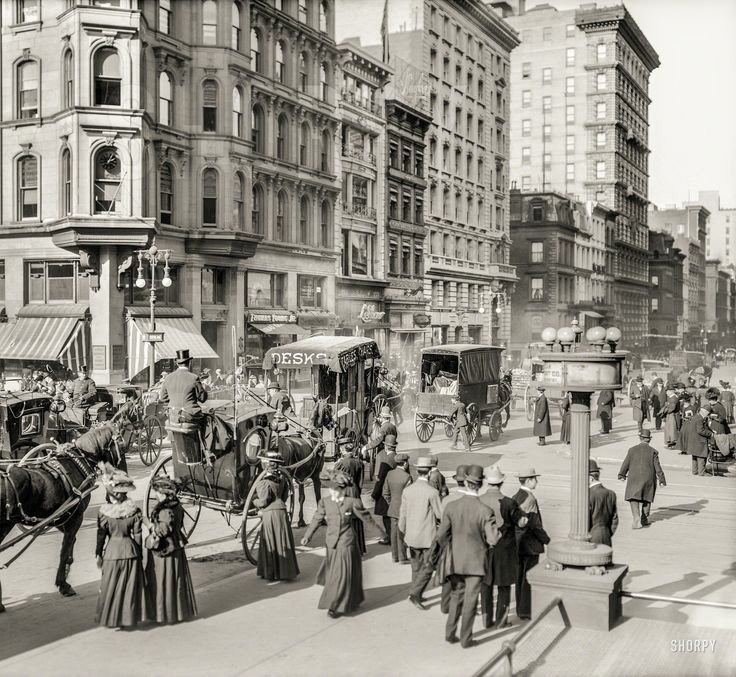
In 1901, most of New York City was unrecognizable to current residents and tourists. The Brooklyn Bridge was up, but across the river, the Empire State Building wasn’t even dreamt of yet, and the Flatiron Building was not yet finished. The towering skyscrapers would be raised later.
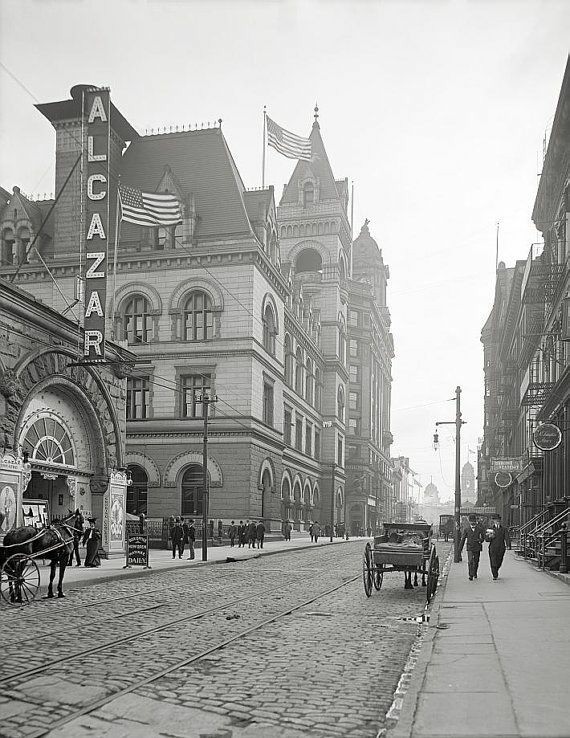
Circa 1901: note the delivery carriages and the dress of the day.Not sure what street this is, but the building is identified as Alcazar Theatre, ca 1906. Again, note the brick road and carriages drawn by horse.
With horseless carriages now on the roads, it was inescapable that tremendous changes were coming. Not everyone welcomes change; too much too fast, and we go into shock from it all. All of the above should amaze you; it does me.
Between 1901 and present day, 119 years all told and soon to be 120, much has taken place. The world became, in ways people living in 1901 couldn’t imagine, a masterpiece of the macabre and the miraculous wrought by humanity. We’ve engaged in the most destructive wars the Earth has ever known, made medicine and vaccines that saved lives, sent men to the moon and the bottom of the sea. Television and motion pictures evolved to a staggering range of abilities including realistic dinosaurs rendered by computers. In 1901, that wasn’t imaginable.
And the brownstone at 455 Sackett Street saw some awful things. Later, much later, a walled-up body would be discovered. Terrible things indeed.
In 1912, the Year of the Titanic, a boy was born to a couple who lived those harsh days with stoicism and firm resolve in the “Irish” part of Brooklyn, where a mere street served as a boundary between them and Italians, and crossing that street meant putting oneself in peril. Gangs ruled both sections, but it would be the Italian Mafia that came to rule all five Burroughs with an iron grip.
Young Frank Cunningham had no idea what he was in for. One day his mother took him with her to visit the graves of friends and relatives. Child and infant mortality was high, and a woman who carried eight babies was fortunate if only one survived. Yellow and Typhoid fever were constant predators, rheumatic fever and everything else including ghastly birth defects were not uncommon. Frank looked at the little graves, not quite understanding how babies could die. The sensitive boy was told that they were angels now. But things make lasting impressions on the young. And when the Spanish flu struck his mother down, Frank was sent to live with a relative. She survived the initial fight, but succumbed not long after. Frank Cunningham learned that the world was unforgiving and grew up constantly reminded of that awful truth.
After growing up to be a man, he enlisted and was discharged just before the attack on Pearl Harbor. He went right back in, serving until the end of World War Two. During that time he slogged across Italy as a corporal gunner in the field artillery. He endured the heat of the North African days and the cold at night. Then, just after D-Day, his unit was assigned to Patton, and the field artillery was a critical component of the Third Army. Of all the weapons the Allies had, artillery was perhaps the most feared by infantry. When Wermacht troops saw or, worse, heard but couldn’t see a spotter plane overhead, there was nothing they could do. Artillery was deadly accurate, and there were different shells used. All of them were terrible, including anti-personnel shrapnel rounds, high explosives, incendiary and white phosphorus.
It was in April of 1945 that an armored cavalry unit entered the Gotha countryside deep in Germany. There had been rumors but not a man there could ever have prepared himself for what they had stumbled upon. Somehow, Frank’s unit had been brought up. Eisenhower and Patton both went into the Ohrdruf concentration camp which fell under the Buchenwald network command. Eisenhower wrote that there was a shed full of stacked bodies and George would not go in, claiming he’d get sick. Both wrote that that bestiality was worse than anything they had seen. Frank never forgot the scene, bodies partially burned on pyres as the German Schutzstaffel, or SS, bugged out, hoping no evidence of their evil would remain. He remembered the stench of decomposing bodies starved or shot, bodies that would have been hard to be close to even when they were alive.
The war ended, Frank came home, entered New York politics, and worked hard to help anyone who needed it. While an alderman he would spend his own money to take turkeys for the holidays to the poor families who otherwise would have celebrated nothing. He understood hunger, suffering on all levels and he was still that sensitive little boy on the inside, the one who found comfort that babies went to Heaven and became angels.
He didn’t speak of the war. He had been through too much, seen too much. He once charged a machine gun nest with two MG 42s, which was either brave, suicidal or both. He earned a Purple Heart and two Silver Stars and he was fine with it, keeping his pain and his extreme hatred for Germans to himself.
But then Frank found the perfect partner in Jane, whom he married. They stayed in love until death parted them. Their daughter caused them a turn or two; in what at the time was Redhook, there were plenty of hazards. Their daughter made friends easily with people who sometimes caused Frank to be concerned, but she also brought home friends who were in trouble, and Frank never turned any of them away. A teen beaten by his father for his sexual orientation was kicked out of his house. Frank let the boy stay, then went to his father and said, “You ever lay a hand on him in anger again, you’ll be sorry.” Then he demanded, “How the hell can you kick your own son out on the street?”
And he meant it. He wasn’t fond of threats, which are always a sign of weakness. If he said he would do something, he’d do it. That was part of his reputation. The man did not, as I know of, ever raise his hand to the boy again.
Another native of Redhook, “Crazy Joe” Gallo, once stopped in the street and spoke solicitously to Frank’s daughter, scaring the little girl. She told Frank about it. She merely described the man and where he was and at what time of day. That was enough that Frank knew it was Joey Gallo. He simply waited on the sidewalk the next day, and when the monster who had been rumored to be part of the hit on Albert Anastasia came along, Frank calmly told him that if he ever went near his daughter again, he’d be really sorry.
And Gallo believed him. The reckless gangster who would die, riddled by bullets, in front of Umbertos Clam House, backed down. He knew that Frank was respected and well-liked, a man of principle, honesty and kindness. He probably understood, somewhere in his dim mind, that those are the guys you least want to piss off.
Frank Cunningham was “hands off”, a respected man. Besides, everyone had kids, and nobody wanted them hurt.
When accidents at intersections began to claim injuries and lives, he was the man to go to. He’d fight for traffic lights anywhere, even outside his district. He was occasionally unsuccessful, but a man who had seen and done so much in his life wouldn’t let someone down. He’d continue to fight for, and he got traffic lights, and undeniably, he saved lives.
Even fighters, though, have their day of reckoning, that one day when they sit across from a doctor and get the worst news of their lives. And so it was for Frank: cancer.
His daughter was married, and she was a nurse. She was pregnant during his end stage, and she took loving care of him as he grew more sick. Soon he was bedridden and she’d lie to him and say she was giving him vitamin shots because he hated painkillers. It was really demerol. One day early in the treatment he became loopy, and remarked that the vitamins were a bit suspicious. He knew, though. Frank always knew the score.
One day, still cold outside, he asked if she would drive him to Coney Island. She was surprised by the request. Was he really up to it? Her mother was sick and couldn’t go, but he wanted to visit the place. His daughter got the car ready, then helped him out to it, and they left. Frank…always knew the score. This would be his last chance to score a Nathan’s and an orange drink; he loved those. He managed to eat most of the Nathan’s and the drink, but couldn’t finish.
He asked to go to the beach, but his daughter knew he could not make the walk. She got permission from one of New York’s finest to drive under the boardwalk and onto the beach. He stood for a while, gazing out at the ocean, then said, “We had some good times here, didn’t we?” It wasn’t so much a question as an acceptance of success as a father and a husband; he’d done his best, but his time was up.
Doubtless he remembered the afternoon when he came home from work and found his wife and daughter in the kitchen, attempting to wash dishes and failing because they were giggling in between fits of mirth. Jane was washing the same plate the whole time he asked each of them how their day was and what exactly was so funny.
It turned out that Jane Cunningham was aware that her daughter smoked marijuana, and, being a responsible mother, she wanted to see what all the fuss was about. So she and her daughter went and smoked a joint. It was, after all, the 70s. A parent should know certain things, right?
Frank probably knew, always knowing the score the way he did, but he never brought it up or pressed. Although evidently his expression gave Jane the idea that it would please him if she left the teenager stuff to their daughter.
As often occurs with end stage patients, there were moments of tenderness and lucidity and a final rally. Frank was being tended to by his daughter one night and he said to her, “Your mother’s birthday is tomorrow. Get me my wallet, please.” She gave it to him, and he picked some currency out and told her which jeweler to patronize, and to get his beloved Jane something nice.
And that’s how he was. A father, a husband and a man anyone can look up to and make even the slightest effort to emulate, and end up a great man.
He talked to daughter Maggie about how they used to go to Mets games, especially one game in the 1969 World Series. And the Jets, and how he had introduced her to Tom Seaver and Joe Namath. She still swears her undying love for Seaver (Tom Seaver died of complications from COVID-19 shortly after this post was first published).
Frank Cunningham never showed any regret that he had no son. To his delight, his daughter went with him anywhere, and was as enthusiastic about sports as he was, and even got a priceless political education from him that no school could touch.
The rally was a wonder. Frank sat up in bed and ate steak and lobster and had a beer. It was wondrous that is, until his daughter realized that rallies often signal that the end is close, very close. His death came as no surprise to her, but her daddy, her teacher, her friend…was gone.
It wasn’t fair. He never got to meet his granddaughter, who was born later that same year. Nor his grandson, who came a few years later. No one should have to go before meeting their grandkids.
But there is always another bit of unfairness waiting on either side of the stage. Jane Cunningham died, leaving Maggie grieving terribly, and she’s never stopped. She knew it had happened. She wasn’t there, but she knew. Maggie senses things, and surely grief has sharpened her ability; she often knows when a friend is in trouble. And, so very often, she’s been called on by a higher power to tend to a friend or neighbor when their last days are near. Frank and Jane Cunningham were such amazing parents that their only child turned into a lightworker, one who helps the dying and the lost to find their way home.
Tragedy sometimes hits families with a force and frequency, though, that seems so unfair as to be a challenge to their faith, their family unit, their ability to keep up or to cope with it all.
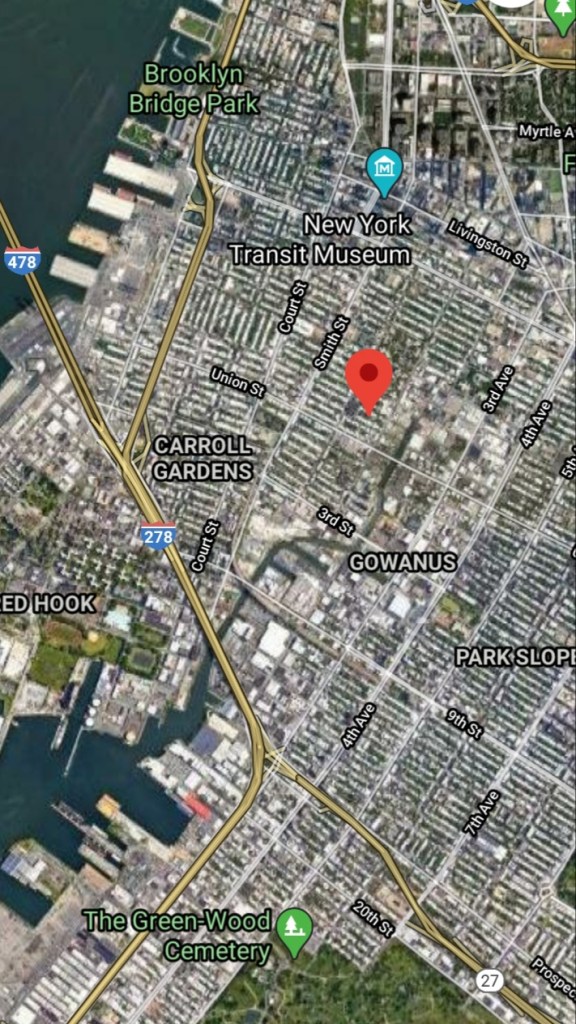
And so we come to the terrifying, terrible part of the saga that is 455 Sackett Street in the Brooklyn neighborhood of Carroll Gardens. Used to be that the whole area was counted as Redhook. And, way back when, there was Mafia violence clean down to the waterfront, where the scaled down operations continue to this day. All five New York Mafia families have always had their fingers in Brooklyn. In the map below, 455 Sackett Street is pinned, but look to its right and notice a dark line extending north to south to the waterfront. That’s the Gowanus Canal, a place that once served as a dumping place where the mobs disposed of bodies.
The site of terrible events in Brooklyn in the 1990s pinned in red.
There have been all sorts of frightening things found in those old homes. Renovating means tearing up floors and ripping drywall. People have found caches of Thompson machine guns, drugs, tunnels, bodies and everything in-between. People making these discoveries include side work carpenters, contractors and do-it-yourself owners. At least some have reported paranormal activity in those homes, though many still prefer to remain silent about such things. Others have told friends in confidence only to have the story grow legs, gain new details and they never say anything about it again.
Now we find Frank and Jane’s daughter, married, two children. They moved into the brownstone in the 90s and Maggie’s daughter, aged 14, said that she didn’t like the house. These days, the brownstones are highly coveted, but that unit was going for cheap. Jane didn’t feel right about it. She wrote this awesome yet disturbing brief of the family’s horrors in the year they lived there.
That’s an horrific story, but unfortunately, it doesn’t end there. True, the fire department could find no reason for the fire. But while there, they had dozens of things happen that go beyond that narrative.
The poor girl was to testify and was treated unforgivably by the district attorney. The slime that raped her taunted her endlessly and threatened to kill her the next time he attacked her. In the courthouse, her mother was sequestered, not allowed into the trial. Meanwhile, the D.A. told the girl that because she was reporting ongoing crimes by her rapist, the court was going to put her in a group home and have uniformed police escort her to and from school. Hysterical, Jane ran from the courthouse, refusing to ever testify. Even therapy didn’t help; her first therapist shamed her by saying she should have testified. Then the guy couldn’t have raped more girls. The rapist was old enough to go to a supermax where, possibly, some guys might not have liked how young his victim was.
First of all, to a young victim, threatening to put her in a group home is heinous. Second, shaming gets done to victims enough by defense lawyers, so coming from a therapist, more trauma is added where there should never be any.
All sexual assault victims feel guilt. It’s something the mind does with that kind of trauma. That kind of experience. Historically, women have had great difficulty getting heard at all, and much more at getting justice, and still more dealing with trauma. It’s evil, all of it, and sickening to even imagine going through. Which is hard. Never can anyone who has not been so assaulted imagine what it’s like.
The trouble continued. Her father was never the same. He felt tremendous guilt that he had not been able to stop his little girl from being savaged so. He had already done brilliant work in his career, he loved his wife dearly, he loved his children and before living in that house, was so devoted to them that he’d give his wife time alone after her shift and take the children to the park. After his little girl was savagely attacked, and so visibly wounded, he began to drink. The drinking went hardcore, to a point his wife told him to leave. Afterward, he literally drank himself to death.
I get where everyone in this tragic story is coming from. My daughter was raped. She was in Junior high school. She walked. I drove her when I could, but then the breakup happened. I wasn’t there. Had I been, she would not have had to walk that day, and wouldn’t have been offered a ride. When she told me about it, we got in the car. She was going to show me his house. I was going to kill him later, after I got her back home. She said, “Dad, I can’t. Take me home. And don’t call the police.” She never said a word about it again.
I understand. As a victim myself, I knew the pain, the trauma. The fear. As a father, I knew the guilt, helplessness and my ultimate failure as a dad.
I, too, went into the bottle. Hard. At one point, I walked to work. One mile each way. After work, I’d buy a bottle and toss the empty on the side of the road or in someone’s yard, since it was dark, before I got home. Before that, I’d lost a job by drying myself out. So I said “fuck it” and started the liquor again.
And I get sibling guilt, too. I had to lie in my bed at night when I was a teenager and listen to my father raping my sisters. I couldn’t stop it, he terrified me. I could have beaten him to death but it wasn’t in my power. That’s guilt you take to the grave; it’s not rightfully yours, but there is no shaking it. Part of the reason I’m happy not having any contact with my blood relatives is that guilt. I got to where I couldn’t look them in the eye anymore.
Like Jane, I had times when I knew, even saw something evil in my room. I’ve told that story, so look through my archives and check it out.
But her troubles continue, as do mine. I’ve come under demonic attack repeatedly. In her current apartment, things go missing. She and her mother and her boyfriend have looked everywhere, and it’s only a studio. Sometimes things stay lost. Sometimes they turn up in places no one would put them.
There are vague apparitions, a face formed on a wall, her health has become frail, she has money problems and nightmares that I suspect are demonically influenced, not just PTSD nightmares. Something is in there.
The mother of the weasel who raped her said she had put a curse on her using Latin voodoo. I have written about curses, and people who say they’re bullshit unless you believe in them are idiots. The woman was “anadept” at whatever she practiced, so it may be true. The varmint had been found hanged in his jail cell after being arrested for more rapes and violent crimes. That’s okay; the world is a better place without him.
But Maggie and Jane, and Jane’s brother, they’re much more than just a tragic story. From a long line of Irish blood, Maggie has raised her family to be stronger than most. Frank Cunningham served his country and raised a daughter whose children are a true reflection of his sense of honor, honesty, loyalty and his resilience. They will not be defeated; they will endure. They inspire me, move me, teach me and they have gotten me through some dire issues, solely because they care. Just as Frank cared; the man who frustrated his wife by writing checks to buy turkeys for poor families. Like that. It’s not just that, either. It comes from love and empathy, the best parts of us.
***
It is never the best of times that give us the tools to fight against things that threaten us or our loved ones. It is always the worst that life can dish out that forms who we become, how strong we are, how much determination we can muster. No one lives without darkness, and evil cannot be escaped in life; it doesn’t work that way. Through the trials we endure, we learn the difference between light and dark and decide which we will live by.
I know a family in New York who I am proud to say I can call my friends. We are family. On my worst days, unable to get up, unable to sleep, unable to even form my thoughts, I need only think of them, and I’ll be on the mend soon enough.
And as terrible as this has been, take heart; if not for that brownstone that predates our country’s flag, I would never have known them at all. We meet people, sometimes, because of an awful, shared experience. It makes no sense, but it is often true.
Update: in March of 2025, Jane Francis Hunter died. She passed away alone, leaving behind a brother, her mother and uncountable friends who grieve. She is no longer in pain. The nightmares have stopped and what remains is our memory of a loving, bright, enthusiastic and extraordinary woman we shall not forget.


 Memoirs of an American Asshole