BROOKLYN CONFIDENTIAL

WARNING

This post contains mature subject matter and certain triggers!

Contents: Fear, Supernatural, Violence and Rape.

If you or someone you know is the victim of rape or sexual assault, call the National Sexual Assault Hotline (800) 656-3673 for directions to help in your area. This is no time to be alone.

***

A terrible saga began in 1901 when a brownstone house was built. No one is left to tell the story of its early days. Some property listings say that it is “prewar” which, these days, is an ambiguous term. You know it means before the second world war, but it also predates the first world war, “The Great War,” as it has been named.

When it was built, the Ottoman Empire still existed. That year, President William McKinley was shot, succumbing to his wounds a week later. Theodore Roosevelt was sworn in.

A summer heatwave killed over 9,000 Americans; air conditioning did not yet exist. Louis Armstrong, Ed Sullivan and Walt Disney were born. They’ve long since left us.

Arizona, New Mexico, Oklahoma, Alaska and Hawaii weren’t yet states, but territories.

The world didn’t notice, nor would it care, that another Brooklyn brownstone was just being built.

The world was a busy place, and the Boxer Rebellion was just coming to an end, Cuba became a protected territory of the United States: future president Batista, who would be deposed by Fidel Castro, was born. Japan was resolute in its efforts to keep Russia out of Korea, and Australia became a sovereign country but retained British “oversight”, and Queen Victoria passed away at age eighty-two. She was succeeded by Edward VII, but most of the power of the Crown had been leached from it by Parliament.

In New York City, Butch Cassidy and the Sundance Kid had left the Wild Bunch, passed through for a photograph and settled in South America. But in 1901, the Wild Bunch went on without them and pulled their last known job, a train Robbery.

Teddy Roosevelt decided that henceforth, The Executive Mansion would be officially known as “The White House.”

Coney Island was just getting its reputation and it changed several times. At first hotels catered to the wealthy, then there came a monstrosity called “The Elephant,” which housed a brothel, and illegal “prizefights” went on out back. Nathan Handwerker wasn’t even attracted to the area until 1916, when the Elephant was gone and beach-and-boardwalk boundaries were finalized. He was the man responsible for Nathan’s Famous Hot Dogs, and when someone wanted a “Coney Island hot dog” and some rings, that’s where they went.

In 1901, most of New York City was unrecognizable to current residents and tourists. The Brooklyn Bridge was up, but across the river, the Empire State Building wasn’t even dreamt of yet, and the Flatiron Building was not yet finished. The towering skyscrapers would be raised later.
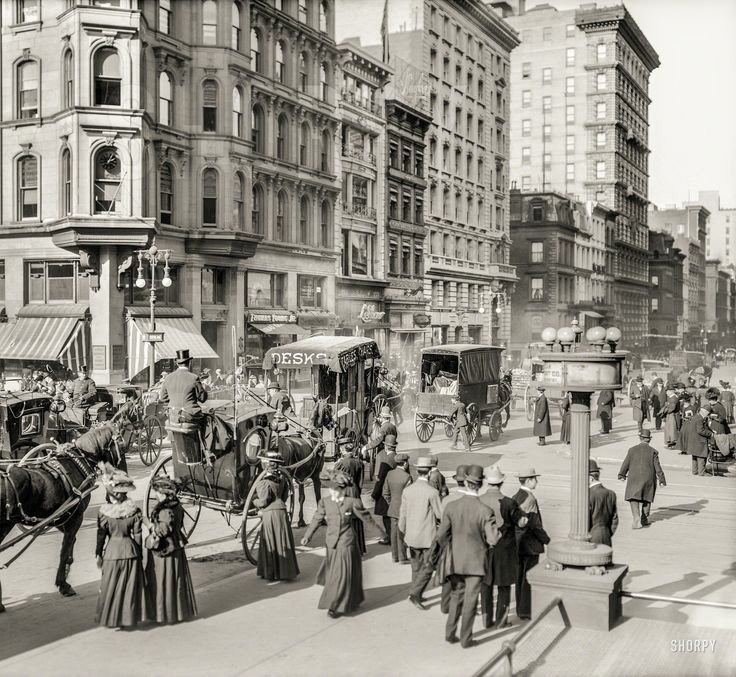
Circa 1901: note the delivery carriages and the dress of the day.
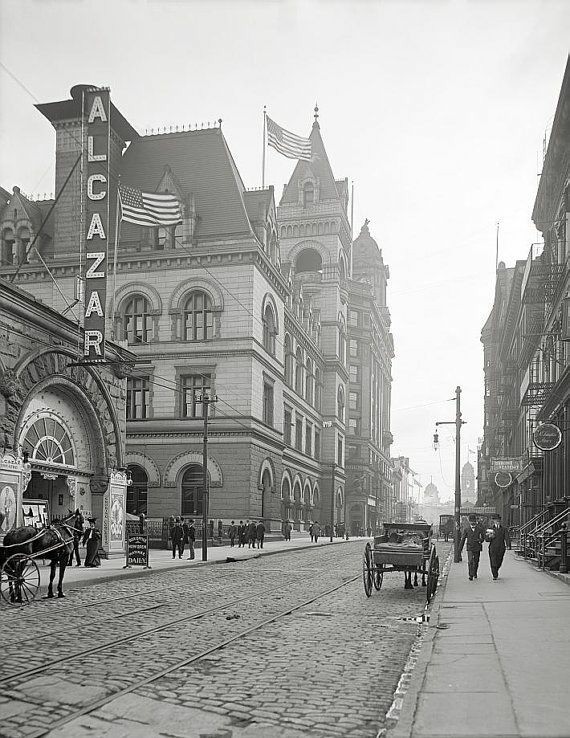
Not sure what street this is, but the building is identified as Alcazar Theatre, ca 1906. Again, note the brick road and carriages drawn by horse.

With horseless carriages now on the roads, it was inescapable that tremendous changes were coming. Not everyone welcomes change; too much too fast, and we go into shock from it all. All of the above should amaze you; it does me.

Between 1901 and present day, 119 years all told and soon to be 120, much has taken place. The world became, in ways people living in 1901 couldn’t imagine, a masterpiece of the macabre and the miraculous wrought by humanity. We’ve engaged in the most destructive wars the Earth has ever known, made medicine and vaccines that saved lives, sent men to the moon and the bottom of the sea. Television and motion pictures evolved to a staggering range of abilities including realistic dinosaurs rendered by computers. In 1901, that wasn’t imaginable.

And the brownstone at 455 Sackett Street saw some awful things. Later, much later, a walled-up body would be discovered. Terrible things indeed.

In 1912, the Year of the Titanic, a boy was born to a couple who lived those harsh days with stoicism and firm resolve in the “Irish” part of Brooklyn, where a mere street served as a boundary between them and Italians, and crossing that street meant putting oneself in peril. Gangs ruled both sections, but it would be the Italian Mafia that came to rule all five Burroughs with an iron grip.

Young Frank Cunningham had no idea what he was in for. One day his mother took him with her to visit the graves of friends and relatives. Child and infant mortality was high, and a woman who carried eight babies was fortunate if only one survived. Yellow and Typhoid fever were constant predators, rheumatic fever and everything else including ghastly birth defects were not uncommon. Frank looked at the little graves, not quite understanding how babies could die. The sensitive boy was told that they were angels now. But things make lasting impressions on the young. And when the Spanish flu struck his mother down, Frank was sent to live with a relative. She survived the initial fight, but succumbed not long after. Frank Cunningham learned that the world was unforgiving and grew up constantly reminded of that awful truth.

After growing up to be a man, he enlisted and was discharged just before the attack on Pearl Harbor. He went right back in, serving until the end of World War Two. During that time he slogged across Italy as a corporal gunner in the field artillery. He endured the heat of the North African days and the cold at night. Then, just after D-Day, his unit was assigned to Patton, and the field artillery was a critical component of the Third Army. Of all the weapons the Allies had, artillery was perhaps the most feared by infantry. When Wermacht troops saw or, worse, heard but couldn’t see a spotter plane overhead, there was nothing they could do. Artillery was deadly accurate, and there were different shells used. All of them were terrible, including anti-personnel shrapnel rounds, high explosives, incendiary and white phosphorus.

It was in April of 1945 that an armored cavalry unit entered the Gotha countryside deep in Germany. There had been rumors but not a man there could ever have prepared himself for what they had stumbled upon. Somehow, Frank’s unit had been brought up. Eisenhower and Patton both went into the Ohrdruf concentration camp which fell under the Buchenwald network command. Eisenhower wrote that there was a shed full of stacked bodies and George would not go in, claiming he’d get sick. Both wrote that that bestiality was worse than anything they had seen. Frank never forgot the scene, bodies partially burned on pyres as the German Schutzstaffel, or SS, bugged out, hoping no evidence of their evil would remain. He remembered the stench of decomposing bodies starved or shot, bodies that would have been hard to be close to even when they were alive.

The war ended, Frank came home, entered New York politics, and worked hard to help anyone who needed it. While an alderman he would spend his own money to take turkeys for the holidays to the poor families who otherwise would have celebrated nothing. He understood hunger, suffering on all levels and he was still that sensitive little boy on the inside, the one who found comfort that babies went to Heaven and became angels.

He didn’t speak of the war. He had been through too much, seen too much. He once charged a machine gun nest with two MG 42s, which was either brave, suicidal or both. He earned a Purple Heart and two Silver Stars and he was fine with it, keeping his pain and his extreme hatred for Germans to himself.

But then Frank found the perfect partner in Jane, whom he married. They stayed in love until death parted them. Their daughter caused them a turn or two; in what at the time was Redhook, there were plenty of hazards. Their daughter made friends easily with people who sometimes caused Frank to be concerned, but she also brought home friends who were in trouble, and Frank never turned any of them away. A teen beaten by his father for his sexual orientation was kicked out of his house. Frank let the boy stay, then went to his father and said, “You ever lay a hand on him in anger again, you’ll be sorry.” Then he demanded, “How the hell can you kick your own son out on the street?”

And he meant it. He wasn’t fond of threats, which are always a sign of weakness. If he said he would do something, he’d do it. That was part of his reputation. The man did not, as I know of, ever raise his hand to the boy again.

Another native of Redhook, “Crazy Joe” Gallo, once stopped in the street and spoke solicitously to Frank’s daughter, scaring the little girl. She told Frank about it. She merely described the man and where he was and at what time of day. That was enough that Frank knew it was Joey Gallo. He simply waited on the sidewalk the next day, and when the monster who had been rumored to be part of the hit on Albert Anastasia came along, Frank calmly told him that if he ever went near his daughter again, he’d be really sorry.

And Gallo believed him. The reckless gangster who would die, riddled by bullets, in front of Umbertos Clam House, backed down. He knew that Frank was respected and well-liked, a man of principle, honesty and kindness. He probably understood, somewhere in his dim mind, that those are the guys you least want to piss off.

Frank Cunningham was “hands off”, a respected man. Besides, everyone had kids, and nobody wanted them hurt.

When accidents at intersections began to claim injuries and lives, he was the man to go to. He’d fight for traffic lights anywhere, even outside his district. He was occasionally unsuccessful, but a man who had seen and done so much in his life wouldn’t let someone down. He’d continue to fight for, and he got traffic lights, and undeniably, he saved lives.

Even fighters, though, have their day of reckoning, that one day when they sit across from a doctor and get the worst news of their lives. And so it was for Frank: cancer.

His daughter was married, and she was a nurse. She was pregnant during his end stage, and she took loving care of him as he grew more sick. Soon he was bedridden and she’d lie to him and say she was giving him vitamin shots because he hated painkillers. It was really demerol. One day early in the treatment he became loopy, and remarked that the vitamins were a bit suspicious. He knew, though. Frank always knew the score.

One day, still cold outside, he asked if she would drive him to Coney Island. She was surprised by the request. Was he really up to it? Her mother was sick and couldn’t go, but he wanted to visit the place. His daughter got the car ready, then helped him out to it, and they left. Frank…always knew the score. This would be his last chance to score a Nathan’s and an orange drink; he loved those. He managed to eat most of the Nathan’s and the drink, but couldn’t finish.

He asked to go to the beach, but his daughter knew he could not make the walk. She got permission from one of New York’s finest to drive under the boardwalk and onto the beach. He stood for a while, gazing out at the ocean, then said, “We had some good times here, didn’t we?” It wasn’t so much a question as an acceptance of success as a father and a husband; he’d done his best, but his time was up.

Doubtless he remembered the afternoon when he came home from work and found his wife and daughter in the kitchen, attempting to wash dishes and failing because they were giggling in between fits of mirth. Jane was washing the same plate the whole time he asked each of them how their day was and what exactly was so funny.

It turned out that Jane Cunningham was aware that her daughter smoked marijuana, and, being a responsible mother, she wanted to see what all the fuss was about. So she and her daughter went and smoked a joint. It was, after all, the 70s. A parent should know certain things, right?

Frank probably knew, always knowing the score the way he did, but he never brought it up or pressed. Although evidently his expression gave Jane the idea that it would please him if she left the teenager stuff to their daughter.

As often occurs with end stage patients, there were moments of tenderness and lucidity and a final rally. Frank was being tended to by his daughter one night and he said to her, “Your mother’s birthday is tomorrow. Get me my wallet, please.” She gave it to him, and he picked some currency out and told her which jeweler to patronize, and to get his beloved Jane something nice.

And that’s how he was. A father, a husband and a man anyone can look up to and make even the slightest effort to emulate, and end up a great man.

He talked to daughter Maggie about how they used to go to Mets games, especially one game in the 1969 World Series. And the Jets, and how he had introduced her to Tom Seaver and Joe Namath. She still swears her undying love for Seaver (Tom Seaver died of complications from COVID-19 shortly after this post was first published).

Frank Cunningham never showed any regret that he had no son. To his delight, his daughter went with him anywhere, and was as enthusiastic about sports as he was, and even got a priceless political education from him that no school could touch.

The rally was a wonder. Frank sat up in bed and ate steak and lobster and had a beer. It was wondrous that is, until his daughter realized that rallies often signal that the end is close, very close. His death came as no surprise to her, but her daddy, her teacher, her friend…was gone.

It wasn’t fair. He never got to meet his granddaughter, who was born later that same year. Nor his grandson, who came a few years later. No one should have to go before meeting their grandkids.

But there is always another bit of unfairness waiting on either side of the stage. Jane Cunningham died, leaving Maggie grieving terribly, and she’s never stopped. She knew it had happened. She wasn’t there, but she knew. Maggie senses things, and surely grief has sharpened her ability; she often knows when a friend is in trouble. And, so very often, she’s been called on by a higher power to tend to a friend or neighbor when their last days are near. Frank and Jane Cunningham were such amazing parents that their only child turned into a lightworker, one who helps the dying and the lost to find their way home.

Tragedy sometimes hits families with a force and frequency, though, that seems so unfair as to be a challenge to their faith, their family unit, their ability to keep up or to cope with it all.

And so we come to the terrifying, terrible part of the saga that is 455 Sackett Street in the Brooklyn neighborhood of Carroll Gardens. Used to be that the whole area was counted as Redhook. And, way back when, there was Mafia violence clean down to the waterfront, where the scaled down operations continue to this day. All five New York Mafia families have always had their fingers in Brooklyn. In the map below, 455 Sackett Street is pinned, but look to its right and notice a dark line extending north to south to the waterfront. That’s the Gowanus Canal, a place that once served as a dumping place where the mobs disposed of bodies.
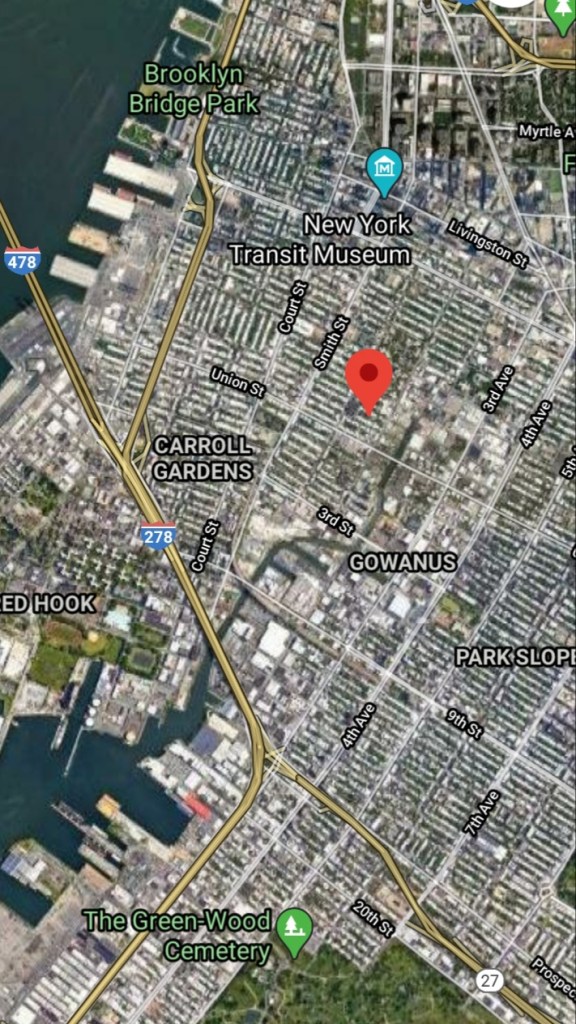
The site of terrible events in Brooklyn in the 1990s pinned in red.

There have been all sorts of frightening things found in those old homes. Renovating means tearing up floors and ripping drywall. People have found caches of Thompson machine guns, drugs, tunnels, bodies and everything in-between. People making these discoveries include side work carpenters, contractors and do-it-yourself owners. At least some have reported paranormal activity in those homes, though many still prefer to remain silent about such things. Others have told friends in confidence only to have the story grow legs, gain new details and they never say anything about it again.

Now we find Frank and Jane’s daughter, married, two children. They moved into the brownstone in the 90s and Maggie’s daughter, aged 14, said that she didn’t like the house. These days, the brownstones are highly coveted, but that unit was going for cheap. Jane didn’t feel right about it. She wrote this awesome yet disturbing brief of the family’s horrors in the year they lived there.

That’s an horrific story, but unfortunately, it doesn’t end there. True, the fire department could find no reason for the fire. But while there, they had dozens of things happen that go beyond that narrative.

The poor girl was to testify and was treated unforgivably by the district attorney. The slime that raped her taunted her endlessly and threatened to kill her the next time he attacked her. In the courthouse, her mother was sequestered, not allowed into the trial. Meanwhile, the D.A. told the girl that because she was reporting ongoing crimes by her rapist, the court was going to put her in a group home and have uniformed police escort her to and from school. Hysterical, Jane ran from the courthouse, refusing to ever testify. Even therapy didn’t help; her first therapist shamed her by saying she should have testified. Then the guy couldn’t have raped more girls. The rapist was old enough to go to a supermax where, possibly, some guys might not have liked how young his victim was.

First of all, to a young victim, threatening to put her in a group home is heinous. Second, shaming gets done to victims enough by defense lawyers, so coming from a therapist, more trauma is added where there should never be any.

All sexual assault victims feel guilt. It’s something the mind does with that kind of trauma. That kind of experience. Historically, women have had great difficulty getting heard at all, and much more at getting justice, and still more dealing with trauma. It’s evil, all of it, and sickening to even imagine going through. Which is hard. Never can anyone who has not been so assaulted imagine what it’s like.

The trouble continued. Her father was never the same. He felt tremendous guilt that he had not been able to stop his little girl from being savaged so. He had already done brilliant work in his career, he loved his wife dearly, he loved his children and before living in that house, was so devoted to them that he’d give his wife time alone after her shift and take the children to the park. After his little girl was savagely attacked, and so visibly wounded, he began to drink. The drinking went hardcore, to a point his wife told him to leave. Afterward, he literally drank himself to death.

I get where everyone in this tragic story is coming from. My daughter was raped. She was in Junior high school. She walked. I drove her when I could, but then the breakup happened. I wasn’t there. Had I been, she would not have had to walk that day, and wouldn’t have been offered a ride. When she told me about it, we got in the car. She was going to show me his house. I was going to kill him later, after I got her back home. She said, “Dad, I can’t. Take me home. And don’t call the police.” She never said a word about it again.

I understand. As a victim myself, I knew the pain, the trauma. The fear. As a father, I knew the guilt, helplessness and my ultimate failure as a dad.

I, too, went into the bottle. Hard. At one point, I walked to work. One mile each way. After work, I’d buy a bottle and toss the empty on the side of the road or in someone’s yard, since it was dark, before I got home. Before that, I’d lost a job by drying myself out. So I said “fuck it” and started the liquor again.

And I get sibling guilt, too. I had to lie in my bed at night when I was a teenager and listen to my father raping my sisters. I couldn’t stop it, he terrified me. I could have beaten him to death but it wasn’t in my power. That’s guilt you take to the grave; it’s not rightfully yours, but there is no shaking it. Part of the reason I’m happy not having any contact with my blood relatives is that guilt. I got to where I couldn’t look them in the eye anymore.

Like Jane, I had times when I knew, even saw something evil in my room. I’ve told that story, so look through my archives and check it out.

But her troubles continue, as do mine. I’ve come under demonic attack repeatedly. In her current apartment, things go missing. She and her mother and her boyfriend have looked everywhere, and it’s only a studio. Sometimes things stay lost. Sometimes they turn up in places no one would put them.

There are vague apparitions, a face formed on a wall, her health has become frail, she has money problems and nightmares that I suspect are demonically influenced, not just PTSD nightmares. Something is in there.

The mother of the weasel who raped her said she had put a curse on her using Latin voodoo. I have written about curses, and people who say they’re bullshit unless you believe in them are idiots. The woman was “an adept” at whatever she practiced, so it may be true. The varmint had been found hanged in his jail cell after being arrested for more rapes and violent crimes. That’s okay; the world is a better place without him.

But Maggie and Jane, and Jane’s brother, they’re much more than just a tragic story. From a long line of Irish blood, Maggie has raised her family to be stronger than most. Frank Cunningham served his country and raised a daughter whose children are a true reflection of his sense of honor, honesty, loyalty and his resilience. They will not be defeated; they will endure. They inspire me, move me, teach me and they have gotten me through some dire issues, solely because they care. Just as Frank cared; the man who frustrated his wife by writing checks to buy turkeys for poor families. Like that. It’s not just that, either. It comes from love and empathy, the best parts of us.

***

It is never the best of times that give us the tools to fight against things that threaten us or our loved ones. It is always the worst that life can dish out that forms who we become, how strong we are, how much determination we can muster. No one lives without darkness, and evil cannot be escaped in life; it doesn’t work that way. Through the trials we endure, we learn the difference between light and dark and decide which we will live by.

I know a family in New York who I am proud to say I can call my friends. We are family. On my worst days, unable to get up, unable to sleep, unable to even form my thoughts, I need only think of them, and I’ll be on the mend soon enough.

And as terrible as this has been, take heart; if not for that brownstone that predates our country’s flag, I would never have known them at all. We meet people, sometimes, because of an awful, shared experience. It makes no sense, but it is often true.

Update: in March of 2025, Jane Francis Hunter died. She passed away alone, leaving behind a brother, her mother and uncountable friends who grieve. She is no longer in pain. The nightmares have stopped and what remains is our memory of a loving, bright, enthusiastic and extraordinary woman we shall not forget.

The Lone Ghost Hunter

It’s one thing to have people call you an asshole. It’s quite another to turn around and prove it. On the 24th of July 1994, I went out of my way to do just that. If you like the ghost hunting shows on TV, you need to know, the real thing isn’t something I recommend. Because I’ve been there. And it’s awful.

In studying the behavioral tendencies in people with PTSD, I discovered something heartbreaking. Well, all of it’s heartbreaking, but one thing in particular stands out, and that is best expressed by the word “extremes.” Often, there’s no fine line, but a wide gap in types of behavior. At one end, you have those who guard their lives and isolate. They become antisocial, forced behind a wall where they’re safe. It can affect everything from social to professional performance and ensure a long term lonely existence in which the victim suffers in silence. It’s no way to live, believe me.

And then, there are the reckless, the risk takers, the suicide jockeys. And I’ve been both. The isolated tend to have limited relationships and while some are rewarding and satisfying, I contend that satisfaction is rare. We all need human companionship, or at least contact. I’ve also been at the other end. This never did fit my personality; I grew up scared of just about everything. I was shy, quiet, and kept to only a few friends, and after a time, fewer still. Seemed I was better at making enemies, and had a knack for attracting the wrong people, especially women. But for a time, I went the outgoing, reckless asshole route. I drove fast, and with PTSD, that’s plain dangerous. The condition leads to dissociative thinking. It’s almost like texting and driving, but worse. I’d be fine one minute, and the next, something had triggered me—a song, an odor, a flash of light—and I was somewhere else, reliving some moment of hell I had gone through, numb and unaware to the world around me. I felt and heard and saw things that had happened to me. Next thing I knew, I was biting the rear end of the car in front of me. In all, before I decided to let my license expire for good, I’d been involved in 35 accidents. That’s like what a race car driver experiences in a whole career, and some don’t even get close to that number.

But recklessness, like refusing to use condoms, which is also pretty much an asshole thing to do, can have results that end up causing even more trauma than the ones already in your head. Serious accidents are, yeah. Traumatic.

I did not know much about PTSD in the summer of 1994. I was only recently diagnosed, and never given any substantial explanation of what it was. I also didn’t know much about the supernatural other than what I had experienced when I was young. So when a girlfriend I was seeing while I was separated from my wife told me about a place called “Ghost Road”, I was half skeptic and half intrigued. I loved to write, and being down on my luck, I devised a plan wherein I would debunk this haunted location and write a story about it. I wanted to submit it to Baltimore Magazine, and see if they would publish it.

The story went like this. There was a lonely road in the area of Bowley’s Quarters near Essex, Maryland. It had a railroad crossing that was haunted. The ghost was that of a newlywed woman who died with her husband when their car stalled on the tracks and a train struck them. The woman walked up and down the tracks with a lantern, searching for the only part of her husband she never found after death: his head. A lurid tale, even if mild by today’s standards. It sounded fishy to me. She took me there, and it turned out that the road had a development of townhomes on the right near the beginning, with older houses on the left. These gave way to woods on either side, leading to a lazy curve which, as we got closer, revealed a streetlight, a wooden railroad crossing sign and a single track crossing the narrow road. Further on, a sharper turn led to a farm, some old homes, and a gated dirt road that led to shore homes. There was nothing remarkable at all about the crossing or the road itself, except for one thing. At first, I didn’t pay any attention to it. I would go back almost every night from April to July, hoping to prove that nothing was there.

I contacted the Baltimore County Police Department. No reports of fatal traffic accidents had ever been filed anywhere on that road. There were no incidents of cars and trains involved in accidents. I contacted the offices of Conrail, which owned the track right-of-way. Again, there had never been any reports of incidents on that section of track; it was explained that it was merely a spur, which is to say, a dead-end track that led to a delivery or pickup site. No trains traveled fast enough on that section where it crossed the road for anyone to screw up bad enough to be hit by it, much less run right into it. I once estimated the speed to be ten miles per hour, maybe fifteen at the most. Because the rail cars being hauled in were hoppers full of coal. They would come back out empty. At the end, roughly to the west, was the Carroll Island Power Plant. A coal-burning power plant, and it wasn’t far from the crossing. So far, the debunking process was going very well. I had the statements by Conrail and the police that nothing described in the ghost story had taken place. And common sense told me that a train moving that slowly was never likely hit anyway. I went into the real research phase, finding out almost right away that the same ghost story was told about virtually every railroad crossing in America where the setting was remote or heavily wooded. This may have become an urban legend, but before that, it had been a folk tale for about a century, and nobody could put pins in a map and cover every “haunted” crossing. It would be impossible.

At the time, I had an eyewitness. I only knew her in a business sense, so there was no reason for her to embellish. She said that she and her husband had, several years before, gone to the crossing and pulled off the road. They would sit in the back of his pickup truck and ghost-watch. And nothing really happened.

Until one night, very late, while they lay on sleeping bags, they began to hear noises at the treeline. They sat up. Nothing happened at first. But then, more and more, they heard things dropping from the trees to the ground, then moving through dead leaves and weeds. They had their night vision from having been there for hours, and they soon saw what was causing the noise: long, black shadows. Shadows. Snake-like, and just shadows. Moving toward them. They bugged out and never went to the place again. Their marriage broke up. When she found out I was investigating the location, she begged me not to proceed further. After what she told me, she grew concerned and her professionalism was gone for a brief second. “You’ll die. Why are you doing this?” Strangely, I never saw her again. But…I didn’t believe her.

Yet there was something about that place. Every time I made the turn onto the road, I felt my blood run cold. At first I counted this as a reaction of fear borne of some sort of expectation, but as I debunked the story, I ruled that out. No, I was sensing something, and it was powerful, though not on a level as what I had experienced as a kid. And that had been bad enough. So, whether I was alone or had my illicit girlfriend with me, I would often stake out the crossing later at night. I couldn’t shake the feeling of danger, but much more powerful was the sense of evil. Just plain evil down there. In April, after a violent thunderstorm, after the rain had stopped and the air was humid but still chilly, I parked on the side of the road with the crossing in sight, but not too close. I began to hear a voice, a woman’s voice, calling someone’s name. It sounded like “Karl” and it continued for hours, just the name, but never swerving in tone or volume. As the sky greyed with approaching dawn, it stopped. Could it be that the story of the widow was true?

I had already debunked that part, so what did this cry mean? I ruled out animals; this was a human voice, no doubt. Now, I had to find out what it was about that road that chilled my blood so, and why a woman had called all night for someone who never answered. I’d thought to look for her, but she would have been difficult to find through dense woods, and besides, I trusted my gut. It told me not to try. I sensed things then that years later, on medication for PTSD and bipolar 2 disorder, I can no longer register. I remember though, how sensitive I was, and that was a curse.

One night, not daring to stakeout the crossing any closer, I parked near the same place as the night I heard the woman. Something stepped out of the woods on the right, backlit by the street light at the crossing. It clearly was walking my way, but there was something immediately terrifying about it. It was no teen who had been toking in the woods. I remembered a scene from “A Nightmare On Elm Street” in which Freddie had very long arms. Although a silhouette, this thing looked similar, long arms stretched to each side. I beat it out of there.

But that just made everything worse. Now there were really sinister things apparent in a concentrated area. The investigation continued. I was terrified to find no other being with arms so long except in American mythology. It was a Wendigo, something reported being sighted just about everywhere except this area.

I wasn’t going to put that in any article. What was with this road?

I didn’t give up. Now I wanted answers. I kept on with my surveillance, but then came the night of 24 July. At two a.m. I approached the crossing. It would be my last pass before calling it a night. But the night was not over.

An oncoming car distracted me. The road was narrow so I had to cross and keep going. But to the immediate left, on the tracks, was a frightening sight. It was nine feet tall, mostly but not fully solid, its legs didn’t touch the tracks, and it had its back to us, going away down the tracks. As if it had just crossed the street. But we had not seen it. Not until we were in the crossing. Cursing, I rounded the curve and did a quick turnaround.

I parked at a gate beside the road that led to a dirt track which paralleled the train track. It was for rail and Baltimore Gas and Electric access, because overhead there were high tension power lines leading from the Carroll Island power plant. With me was the woman I was seeing, and her son. I looked down the track. The thing was still there, but further away than what my reason told me it could be. If I was going to get a look, I had to move. I said to her son, “Let’s go, dude.” I got out and started chasing the thing.

It was covered in a tan cloak like Sherlock Holmes wore. It came to knee length, but had no legs visible below the hem. It had a matching round hood, almost laughably big. And no matter how fast I ran, I couldn’t gain on it. Ahead of it was total darkness, and a lazy, long curve to the right. I was a quarter mile from the car when it suddenly pivoted as if on an axis and now it was coming toward me fast. Frozen in fear, I looked at it and saw that inside the hood there was nothing but darkness. It had no head. And the cloak parted at the waist, revealing two running legs from the knee to the groin; no sign of lower legs.

My lady friend yelled down the alley between the pines, “It’s coming back!”

Yeah, I saw that. I turned on my legs. They had turned into licorice strands. And I was alone. Dude had stayed in the car.

It was a helpless feeling. All I knew was that my life was in danger; I tried to run, but it wasn’t working. I felt the thing behind me, closing up the distance between us. I thought I was going to die.

Finally my legs moved. I ran back to the car and grabbed the door handle. They told me that the thing was close enough to grab me but vanished as I touched the door.

There has rarely been a time when I looked back and have not thought that I could have been hurt that night. I’ll never ghost hunt again. Because even an asshole has to have limits.

The Angel Of Death

There’s one thing I find terrifying. He, or she, is real.

The Angel of Death.

Back in 2008-09, I was on MySpace. I blogged there. I was not always well, or stable in mood. I did things that hurt people. I hate to say it, but secluded at a keyboard and free to type anything I wanted, I drew darkness toward myself. I was adrift in an ocean of free porn. I began to heighten my sensitivity to the supernatural. The group home I was staying in was built in 1900. Oldest place I ever lived in. And if you don’t believe in the supernatural, good for you. At least you’re less open to experiences that could change your mind. But I found that the age of the house had a bearing on what kind of environment it held within. In 1900, there was still an Ottoman Empire. The street I lived on was a dirt track. The property had a stable, perhaps even a carriage house. World War One hadn’t happened yet. Thinking about all the history of the world that had not been seen yet when the house was built staggered me. Soldiers who would fight at Normandy and Iwo Jima had not even been born. Wow.

But my medication list wasn’t dialed in quite right. PTSD w/Severe Depression was but one of my page-long list of maladies; I was sick. And I had already learned that when I wasn’t medicated properly, I was very much open to the supernatural. One part of this was that I would have premonitions and an uncontrollable curse of seeing into the thoughts or feeling the emotions of others. Always, without fail, these were negative; that is, I felt anger, lust, hatred, jealousy and more, and often I knew these weren’t my feelings. It usually happened when I was exhausted, had been dehydrated, and was depleted of everything that provided a healthy defense and strength. One very awful day in the summer of 2003, I got a taste of just how bad this curse really was.

I was standing near the corner of the house where I rented a room from my ex and her husband. It was stressful but at least I could spend more time with my son. For the record, I wasn’t on any medicine. I was exhausted and definitely dehydrated, weak, and did not imagine that what was about to happen was even possible, because it’s movie or bad novel shit. I was looking up the street, for some reason staring at this red pickup truck. I zoned. Then I was in a trance-like state. Not thinking, no longer aware of what my eyes were seeing. Suddenly I was in a bedroom, and I saw the owner of the truck. He didn’t live there; he did handyman work for the widow who owned the house. She was on vacation with her son and would be away for the entire week. I saw him, saw that it was her bedroom. He had the top drawer of her dresser open, and his hands were in it. Before that could register and I could perhaps snap out of it, I was in his body! Not astral projection; I was just seeing through his eyes as he felt his way through her panties. His hands were my hands. I could feel it, then see the colors. Teal. Black. White. I felt a sickening thrill, a very dirty surge of some sexual appetite slowly being fed bits of satisfaction by that which was forbidden, violating. It only lasted a few seconds, then I was out of it, aware of my real surroundings. After that I was sick, for three days, with a migraine and exhaustion made worse by the awful depleting nature of the surge of emotions I had felt. When they got home, her son came down to visit. At the risk of putting myself in the cuckoo category, I had to tell him what I saw. What I knew. And it turned out, well, it went like this: I asked him, “Does your mom’s bedroom have beige carpet?” I had never been in that house.

“Yes.” He became uncomfortable.

“Does she have an upright dresser?”

“Yeah, go on.”

“And if I stood at her dresser, is her door on my right?”

“Go on.” He shifted on his feet. We were on the porch.

“And does she have teal underwear?”

“Stop!”

“Yeah. I saw this through Bacon’s eyes. I don’t know, Jerr, I zoned out staring at his truck, and I was suddenly looking through his eyes, staring at her underwear, and he was going through them, feeling–”

Enough,” he said.

“I had to tell you. It’s not like I can knock on the door and tell her this.”

“Hell, Mike, I can’t tell her this. She’ll think you’ve been spying through her window.”

“Jerr, she has to know. She has to know he’s dangerous, he’s a hungry animal, the worst kind. Don’t let her get more involved with him. Tell her to break contact. He’s dangerous.”

Ever since her husband died, Bacon had been helping her, and his motive was to move in. I knew if he did, if she was lonely enough, she would be in danger. I had felt his hunger. It was primal, evil.

Her son finally did succeed, without mentioning me, in getting her to send the fucker down the road. This is the curse I bear. In the group home, a few years later, after three suicide attempts, I was in treatment. But in the house in Elkridge, I was off-kilter, and the problem with psychotropic drugs is, you gotta have them all just right. Drop to the low side, or worse, get to the upper tolerance limit, and bad shit happens. And I could see and feel and hear things I wish I didn’t. In that hundred-year-old house.

I would go downstairs in the middle of the night. I have always had trouble sleeping properly, so I’d go outside for a smoke. Descending the stairs, I could hear someone moving in the dining room. But when I turned the corner, no one was there. I heard it in the kitchen, the next room. Again, empty. Outside was just as unnatural at night. Sometimes there was an oppression, a suffocating feeling to the air. Sometimes, as when a possum was hunting ticks in the grass, I knew nothing bad was around; animals are very keen to the presence of spirit activity. Other times it was just too quiet, eerie, and honestly a bit frightening. I knew there were spirits, inside and outside of the place, and considering the age of it, why not?

One night, cold and sprinkling rain, very dark. I had my window open a crack. I was writing a blog on MySpace. I didn’t know how long it had been going on, but gradually I became aware that in the street below, a woman with high heels was walking around in a circle. And she was trying to get my attention. I raised the window and looked out, but in the gloom I saw nothing. That’s when she stopped walking in a circle, walked from my right to my left, right in front of and beneath me. I still saw nothing. I bounded down the stairs, out of the door that was right next to the street. Nothing.

I saw no one and the heel steps were gone. With a suddenness, I looked at the house across the street and one lot to the left. I’d always considered it creepy, and in the two years I’d lived in the old house, that one had gone through two owners. Not renters, owners. That’s a red flag. It now sat empty. And every time I was near a window that faced it, or went outside, my attention, my eyes, we’re always drawn to it. That house was the only place the woman in heels could possibly have gone. But… It was vacant. My blood ran cold. Although I sensed no threat, not to myself anyway, I was filled with the feeling that it was a bad experience. If I hadn’t had so many, perhaps I could have ignored it. But I knew there was a lot more to life than what met the casual eye, and I knew this was something that I was supposed to pay attention to.

A few weeks passed. A friend of mine named John died suddenly, walking on the road near his house. Massive coronary. Dead before he hit the ground.

A couple of months passed. It was now summer. A hot day. I was in the bathroom. The window was open. The woman in heels walked past, one story below, and the window faced that house, still vacant. She came from the same direction, my room. Walked right below me. This time in bright sunshine, but I again saw no one. And her footsteps faded going up the driveway to that house.

I had researched the house in the intervening months. All I found was that it was built in 2000. One hundred years after the one I lived in. I saw the price the last owner settled on. Nothing else. No stories reported any crimes or deaths there. I looked at it on Google Earth. It had an in ground swimming pool. Something told me that there was an accidental drowning in it. Other than that, I couldn’t read the house; it defied my efforts to even concentrate long enough to see inside it or any residue from any unfortunate events. Yet my eyes we’re still drawn to that house every time I was outside. And not just to the house; to the large windows of an upstairs bedroom. Always with the feeling I was being watched.

A few weeks after hearing the invisible heels walk by, another friend, also named John, died of liver failure.

Someone I confided in suggested it had been the Angel of Death, come to warn me that I was about to lose someone I loved.

If the story ended there, I wouldn’t bother telling it.

But it doesn’t, no story so awful ever ends that simply.

In summer, 2012, the house was still vacant. People who did a walk-through never came back. I listened for the Angel of Death, but she never walked past again. Then something terrible happened.

My daughter had been abandoned by her husband. She’d lost her place. After living with her young son in her car, she finally came home. She visited me one day, and for some reason, I pointed out that house. I told her not to go near it. I don’t know why I did that. I told her it was a place of evil… And death

To be honest with you, 2012 was a weird year here in Maryland. First there was a derecho, a storm uncommon in the east because it is characterized by powerful straight-line winds which rarely make the trip intact over the Appalachian mountains. The bloody thing nearly blew me over the railing of the deck.

Then there was a much more frightful day. 13 tornadoes hit the state and there would have been more, but some didn’t touch down. It was a weird, scary time.

And one night, after 23:00 hours, she showed up to visit. I couldn’t let them in because of rules, and the late hour. I went out to talk and saw to my horror that she had parked in the driveway of the vacant house. Almost against the garage door!

I warned her, “Beth, you can’t be on that property”, and we hugged and kissed and she went home. She had a party to go to on July 4th, but said she would visit me on the 5th.

I never saw her alive again.

My son called late in the day of the 4th. There had been an accident. My Elizabeth had drowned. She was at St. Agnes Hospital in Baltimore. Full life support. Next day I got a ride to see her. It was a heartbreaking sight. My ex-wife said “Beth, your daddy’s here”. A tear, just one, slid from an eye. I thought she might have heard her mom, but it wasn’t possible. To determine the amount of brain damage, they had her chilled. When they warmed her, they discovered that there was never any blood getting to her brain stem. She’d been dead a full day. They turned the machine off.

I was broken. I asked God why, why her?

It wasn’t fair. It wasn’t right!

WHY? WHY, ABBA?

Why couldn’t it be me? Hell, I didn’t even want to live. She had three children. My life served no purpose. Hers did.

I questioned everything I had ever believed about God. I still do.

But my children would not want me to. I’m still very much a Christian.

My faith is weak. And I see shadows in my room. I know my time is limited.

My children are dead and I cling to the hope that they are together in Heaven. But I can’t know that. I sometimes agonize over that question. I ask Abba, the Father, to have mercy on them and I tell him please, don’t punish them for having a father who was an asshole.

I wish I had done better. Every day they are with me in this shattered heart of mine. When the Angel of Death comes for me, I will not be afraid. Living, for me, is more terrible than death. What scares me about the Angel of Death is that she’s always coming for someone else; never for me. I beg you: hug and kiss your kids. Take a prime interest in all they do. You are the one who can save them. You are the one who can redeem me by making sure my plea counts. And in so doing, save yourself the heartache of regret and an empty hole where they used to be.